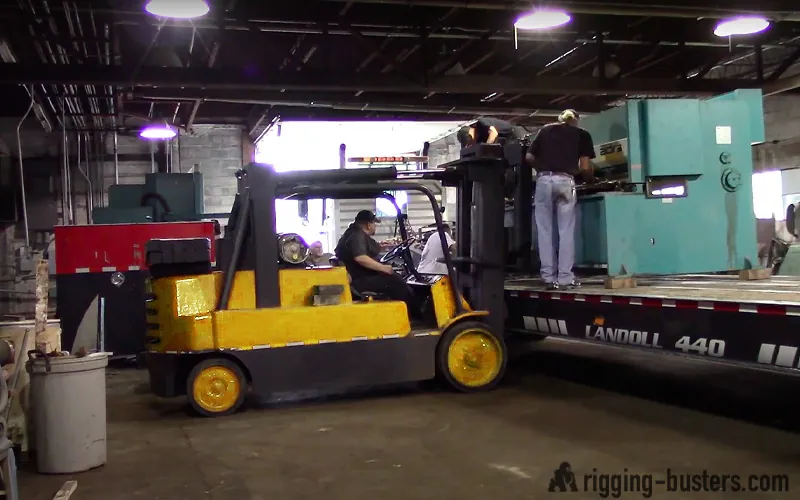
Rigging-Busters moves machinery and heavy equipment across Ontario as one job. Our riggers take the machine off its foundation, load and secure it on the right trailer, haul it under the permits the load needs, then unload it and set it in place at the new site. You don’t have to coordinate a trucking company and a separate rigger.
We work for plant and maintenance managers, equipment dealers, auction buyers and integrators: a CNC machining centre going from a shop in Concord to a plant in Windsor, a press bought at an auction in Hamilton, or a whole line moving from Mississauga to a new building in Cambridge.
- Industrial only: machines and plant equipment, with no household moves, vehicles or general freight.
- Riggers at both ends: rig-out, loading, the haul, unloading and set-in-place, planned as one move.
- Minimum job: 3,500 CAD. Most rigged machine moves cost more, and your written quote shows the full price before work starts.
- Quick replies: quotes within 2–4 business hours, and estimates are free.
- Insured: liability and workers’ compensation insurance (WSIB in Ontario), with a certificate of insurance on request.
Want a budget figure before you send the details? The Heavy Lifting & Moving Calculator gives a rough price range in a few minutes.
or give a call +1-647-846-5179
Machinery Transport With Riggers at Both Ends
Most heavy equipment transport is sold as a truck and a driver, and driving is the simple part of moving a machine. The risk sits at each end: getting a 20-tonne press out through a dock door, onto a trailer and into a new building without damage. Heavy-haul carriers move construction equipment that drives on and off; a machine that can’t drive needs riggers with skates, gantries, jacks or a forklift of the right capacity, and a plan for the floor and the doorways.
We plan the whole move as one job, from rig-out to set-in-place, so nothing falls between a trucking company and a separate rigging contractor.
What We Transport
Our heavy equipment hauling is for machines that have to be rigged on and off the trailer:
- CNC machining centres, lathes, grinders and other machine tools
- Presses, press brakes, shears and coil-processing lines
- Injection moulding machines with their robots and auxiliaries
- Transformers, switchgear and generators
- Conveyors, packaging lines and production-line sections from a plant relocation
- Printing presses, compressors and other heavy plant equipment
Not a Fit
Float-only hauls of excavators and other construction equipment under our minimum job, cars and vehicles, general freight (FTL or LTL), household goods and safes, and crane rental on its own. For those, a heavy-haul carrier or a moving company will serve you better.
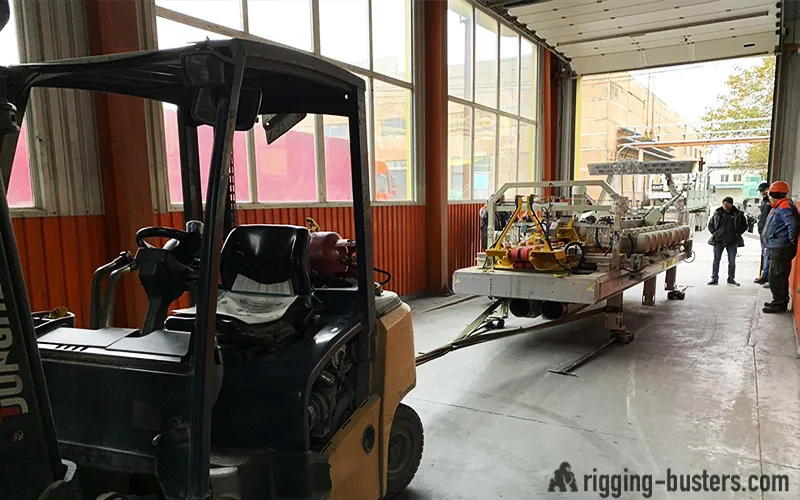
How a Machinery Transport Job Runs
Every move follows the same seven steps, whether it is one machine or a plant’s worth:
- Job review: make, model, shipping weight and dimensions, photos, both addresses and your dates.
- Site check at both ends: doors and docks, floor capacity, overhead lines and where a trailer can stand.
- Move plan: rigging method, trailer type, the route, and the permits and escorts the load needs.
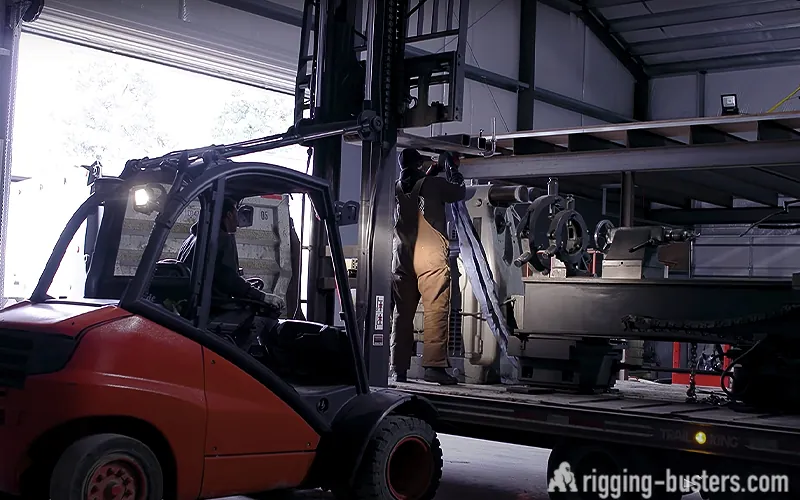
- Rig-out and loading: the machine is prepared for the road, then rolled, jacked, lifted or forklifted onto the trailer.
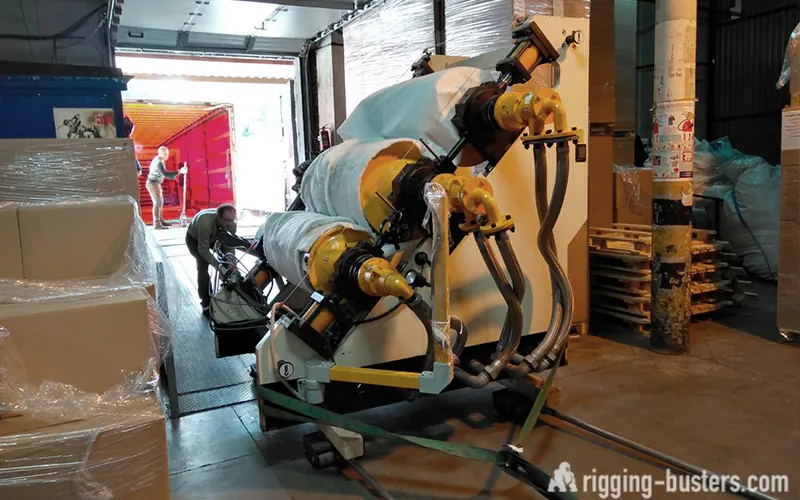
- Securement: blocked, braced and chained, with sensitive parts wrapped against road spray.
- The haul: on the permitted route, inside the permit’s dates, with escorts where the permit calls for them.
- Unload and set: the machine is rigged into the new building and set on its marks, ready for levelling and start-up.
Preparing a Machine for the Road
Before a machine leaves the floor, its moving axes, tables and heads are locked with the OEM’s shipping brackets, and tooling and loose parts come off to travel separately. Your licensed electricians disconnect power, and your maintenance team or the OEM drains fluids where the manual calls for it. Our riggers take it from there.
How the Load Is Secured
Ontario enforces the national cargo securement standard, NSC Standard 10, through O. Reg. 363/04. The chains and binders holding a machine must have a combined working load limit of at least half its weight, and the number of tiedowns grows with its length: at least two for a machine up to 3.04 m long, plus one for each further 3.04 m or part of it. The base is also blocked against shifting, and electrical cabinets and machined surfaces are wrapped for the road.
or give a call +1-647-846-5179
Choosing the Trailer: Flatbed, Step-Deck, Lowboy (Float) or RGN
In Ontario, a loaded truck may be up to 4.15 m high and 2.6 m wide without a permit. The trailer’s deck height decides how tall a machine can be inside that limit, so we choose the trailer from the machine’s real height, weight and footprint, and from how it will be loaded.
| Trailer | Deck height | Tallest machine within 4.15 m | Best for |
|---|---|---|---|
| Flatbed | about 1.5 m | about 2.6 m | Skidded or crated machines and line sections loaded by forklift or crane from the side |
| Step-deck (drop deck) | about 1.0 m | about 3.1 m | Taller machine tools, presses and cabinets loaded from the side or the rear |
| Lowboy (float) or RGN | about 0.5 m | about 3.6 m | The tallest and heaviest machines; the front of an RGN comes off so loads can roll or skate on |
| Tilt-deck | tilts to the ground | depends on the machine | Forklifts, press brakes and machines winched or skated aboard without a crane |
A load over 4.15 m high or 2.6 m wide needs an oversize permit, and for a single-trip permit above 4.26 m, MTO requires a low-profile trailer. Weight decides the axle set-up and the permit class, so we need the machine’s real shipping weight, not the catalogue figure.
Oversize Permits in Ontario: MTO, Cities and Escorts
A machine that pushes the load past the Highway Traffic Act limits needs a permit from every road authority on the route: MTO for provincial highways, and the city or region for their own roads. The permits, the route and any escorts are planned before the move date.
MTO Single-Trip Permits
On King’s highways such as the 401, 400 and QEW, an oversize or overweight load needs an MTO oversize/overweight permit, applied for through the PRIO online system at least 5 business days before the trip. A single-trip permit covers one route for up to 7 days. Fees are $66.25 for an oversize-only load; for an overweight load up to 120,000 kg, $127.50 for up to 100 km, $204 for 101 to 500 km and $265.25 over 500 km. A superload above 120,000 kg costs $714 and needs certified superload escorts and a traffic management plan.
City of Toronto Oversize Load Permit
On City roads, a truck and load reaching 4.15 m high, 2.59 m wide, 21.33 m long or 50,000 kg needs a single-trip oversize load permit. The application needs a $2 million certificate of insurance naming the City as an additional insured, Metrolinx sign-off where the route calls for it, and a check for streetcar and subway crossings. Processing normally takes 7 to 10 business days, and the fee is $66.41 plus HST per trip ($83.01 inside a Construction Hub).
Peel, Hamilton, Waterloo Region and Windsor
Each region sets its own rules and lead times, and our local pages cover them: excess load permits in Mississauga and Peel Region, oversize load permits on Hamilton roads, permits for machine moves on Cambridge roads and City of Windsor and Essex County permits.
Escorts, Restricted Roads and Spring Limits
In Toronto, pilot vehicles are required at 3.7 m wide, 4.15 m high, 24.5 m long or 63,500 kg, and MTO or City conditions can also call for a police escort. Oversize loads may not use the Don Valley Parkway, Black Creek Drive, the Allen Expressway, the elevated Lake Shore Boulevard West or the Gardiner east of the Humber River, and the permitted route must be scouted 48 hours before the move. In spring, reduced load periods on many municipal roads can rule out the shortest route for a heavy machine.
or give a call +1-647-846-5179
Machinery Transport Cost in Ontario: What Affects the Price
Machinery transport is priced per job, once we know the machine and both sites. The main cost drivers are:
- Rigging at each end: skates, gantries, jacks, a heavy forklift or a crane at pickup and at delivery
- Size and weight: they decide the trailer type and the permit class
- Distance and route: kilometres, and detours around low bridges and restricted roads
- Permits and escorts: MTO fees from $66.25 for an oversize-only trip to $265.25 for an overweight trip over 500 km, plus municipal permits and pilot vehicles
- Timing: shutdown windows, nights and weekends, and waiting time at either end
- Storage between pickup and delivery, when the new site isn’t ready
Jobs start at 3,500 CAD, and most rigged machine moves cost more. For a rough range, try the Heavy Lifting and Moving Calculator, or see how jobs are priced on our pricing page.
Areas We Cover in Ontario
We move machinery to and from the GTA: Toronto, Mississauga, Brampton, Vaughan, Markham, Oakville, Milton and Durham Region. We also haul along the 401, 403 and QEW corridors to Hamilton and Niagara, Waterloo Region and Guelph, London and Windsor, and east to Kingston and Ottawa.
For a move within one city, see machinery movers in Toronto, Mississauga, Brampton, Hamilton, Kitchener-Waterloo, London, Windsor and Ottawa.
or give a call +1-647-846-5179
Why Ontario Plants Use Us for Machinery Transport
- Riggers, not just drivers, at pickup and delivery, so the machine is handled by people who know where to lift it.
- The right trailer for the machine, chosen from its real height, weight and footprint.
- Permits, escorts and the route planned before the move date, around restricted roads and spring limits.
- Loads secured to NSC Standard 10, with blocking, chains and weather protection.
- Work around production: shutdown windows, nights and weekends.
- Quick answers: quotes within 2–4 business hours.
A good fit: single machines and multi-machine moves between plants, new equipment from dealers, auction purchases, and plant relocations across Ontario.
Have These Ready for an Exact Quote
Send these with your quote request and we can price the move without guesswork:
- Machine details: make, model, shipping weight, length, width and height, and any parts that come off
- Photos: the machine and the way out of the building
- Addresses: pickup and delivery, with a contact at each site
- Access at both ends: dock or door sizes, floor condition, overhead lines and where a trailer can park
- Loading: our riggers at both ends, or your own forklift or crane at one end
- Dates: pickup and delivery windows and any shutdown dates
- Site rules: WSIB clearance, insurance certificates, union or prequalification requirements
Other Services in Ontario
Browse all our services in Canada, or go straight to a related service:
- Machinery & Heavy Equipment Movers in Ontario
- Heavy Equipment Loading & Unloading in Toronto, ON
- Industrial Rigging Services in Toronto, ON
- Crane Rigging & Heavy Lifting in Toronto, ON
- Millwright Services & Machinery Installation in Toronto, ON
- Millwright & Machinery Installation in Hamilton, ON
- MRI & Medical Imaging Equipment Rigging in Ontario
Machinery Transport in Ontario: FAQ
Heavy machinery transport is priced per job: the rigging needed at each end, the machine’s size and weight, the trailer, the distance and the permits set the price. MTO single-trip permit fees run from $66.25 for an oversize-only load to $265.25 for an overweight trip over 500 km, and city permits and escorts add to that. Jobs start at 3,500 CAD. For a rough range, use our Heavy Lifting and Moving Calculator.
You need one when the truck and load go over the Highway Traffic Act limits, such as 4.15 m high or 2.6 m wide, or over the legal weight for the axles. MTO permits cover provincial highways only, so city and regional roads need their own. In Toronto, a load reaching 4.15 m high, 2.59 m wide, 21.33 m long or 50,000 kg needs the City’s single-trip oversize load permit.
Plan on two to three weeks when the load needs permits. MTO asks for single-trip applications at least 5 business days before the trip, and the City of Toronto normally takes 7 to 10 business days. Superloads over 120,000 kg also need certified superload escorts and a traffic management plan, so they take longer. A legal-size load can often be booked sooner.
It depends on the machine’s height, weight and how it is loaded. A flatbed deck sits about 1.5 m off the road, so a machine up to about 2.6 m tall stays under Ontario’s 4.15 m limit; a step-deck allows about 3.1 m and a lowboy or RGN about 3.6 m. The heaviest machines go on a lowboy or RGN, and for a single-trip permit above 4.26 m, MTO requires a low-profile trailer.
We load and unload it. Our riggers take the machine out of your building, load and secure it, then unload it at the other end and set it on its marks, ready for levelling and start-up. If you have your own forklift or crane at one end, tell us and we plan the move around it.
Ontario applies the national cargo securement standard, NSC Standard 10, through O. Reg. 363/04. The tiedowns’ combined working load limit must be at least half the machine’s weight, and a machine longer than 3.04 m needs more than two tiedowns. Moving parts are locked with the OEM’s shipping brackets, the base is blocked against shifting, and cabinets and machined surfaces are wrapped.
Yes. Auction removals have fixed pickup windows and the auctioneer’s own site rules, so send the lot number, the removal deadline and the site’s requirements with your quote request. We rig the machine out, load it, haul it under the permits it needs and set it in your plant. For whole plant clear-outs, see plant closure and auction removal in Toronto.
Not as a float-only haul under our 3,500 CAD minimum: a heavy-haul carrier is the better choice for a machine that drives on and off the trailer. We focus on industrial machinery that has to be rigged out, loaded, secured and set in place. If construction equipment is part of a larger plant move, include it in your quote request.
Oversize loads may not use the Don Valley Parkway, Black Creek Drive, the Allen Expressway, the elevated part of Lake Shore Boulevard West between Rees Street and Dan Leckie Way, or the Gardiner Expressway east of the Humber River. The part of the Gardiner west of the Humber, the former QEW, is allowed. The permitted route must be scouted 48 hours before the move.
The machine’s make, model, shipping weight and dimensions, photos of it and the way out, both addresses, and the access at each end: docks, doors, floor and overhead lines. Add your dates, any shutdown window, who loads at each end and your site rules, such as WSIB clearance or insurance certificates. Send them with the quote request form, and we usually reply within 2–4 business hours.