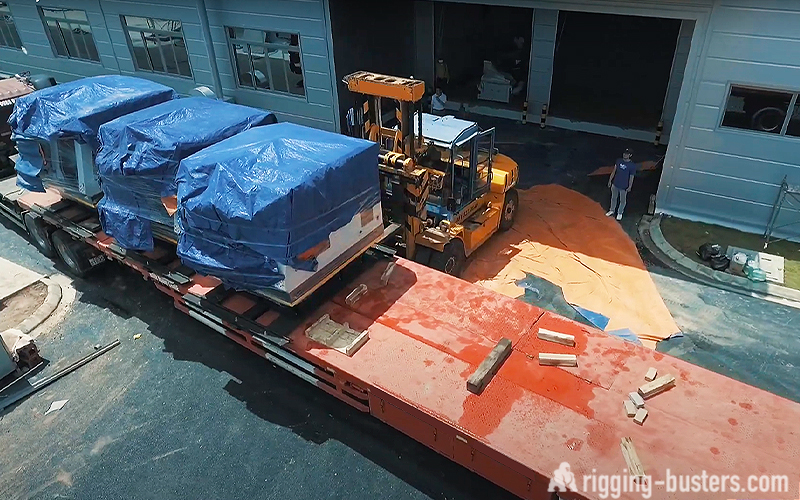
Need cross-border machinery moving between Ontario or Quebec and the United States or Mexico, for one machine, a production line or a whole plant? Rigging-Busters runs it as one plan: rig-out at the old plant, crating where the destination needs it, the machine data your customs broker needs, permits and bridge bookings for the whole route, then set-in-place, levelling and millwright installation at the new plant. Moves north into Ontario and Quebec are planned the same way.
We are a machinery moving and rigging company that provides professional riggers and lifters, with one crew for rigging, transport, set-in-place, levelling and millwright installation. Typical international machinery moves: CNC and machine tools, presses, production lines, transformers, lab equipment and whole plants.
- Industrial only: machines, lines and plant equipment. No household goods, vehicles or general freight.
- One plan across the border: rig-out, crating, the permitted haul and installation, in either direction.
- Data for your customs broker: make, model, serial number, weight and size of each machine, from our survey.
- Minimum job: 3,500 CAD. Priced per project, before tax, so single small items are not a fit.
- Quick replies: quotes within 2–4 business hours, and estimates are free.
- Equipment: jack-and-roll systems for loads up to 600 tons, hydraulic gantries, lift trucks up to 60,000 lb and float trailers for loads up to 50 tons.
- Insured: liability and workers’ compensation insurance (WSIB in Ontario), with a certificate of insurance on request.
Not sure yet who the importer of record is, or which crossing suits the load? Send what you know with your quote request.
or give a call +1-647-846-5179
Who Needs International Machinery Movers
Cross-border moves usually start with one of these projects:
- Lines moving south: an Ontario or Quebec plant moving a line or the whole plant to the US or Mexico.
- Lines coming north: production brought back to Canada, or a new line for an Ontario or Quebec plant.
- Consolidations: two plants on either side of the border merged into one.
- Used machinery: machines bought from a US or Mexican plant, dealer or auction, or Ontario auction lots sold south.
- OEM installs: new machines built in the US or Mexico, set in place for the maker’s start-up crew.
Public announcements show production moving both ways: auto-parts motor work from St. Thomas to Reynosa, Tamaulipas (October 2026), chemical production from Maitland, near Brockville, to Texas in phases (September 2025), furniture production from Lindsay to US plants (October 2025), and switchgear sub-assembly work from the US back to Harrow (March 2026).
How a Cross-Border Machinery Move Runs
Every move follows the same eight steps, from one press to a full plant:
- Survey: make, model, serial number, weight, dimensions and photos of each machine, and access at both buildings.
- Disconnects: your licensed electricians and other licensed trades isolate power, air, water and gas.
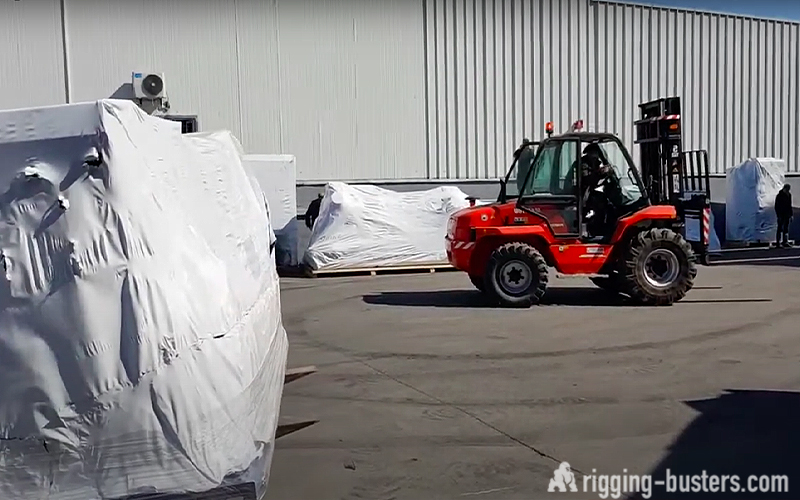
- Rig-out and packing: machines lifted off their anchors, moved out on skates, jacks or gantries, and wrapped, skidded or crated.
- Data for the paperwork: survey details go to you and your customs broker for the commercial invoice, packing list and any CUSMA/USMCA claim.
- Permits: MTO or MTMD for the Canadian leg and one per US state, with escorts where required.
- Border crossing: the carrier’s eManifest sent ahead, the export declaration filed by the exporter or its customs broker where needed, and the bridge booked for oversize loads.
- Delivery and installation: set-in-place, levelling, alignment and millwright installation.
- Start-up: your licensed electricians reconnect power, and your team or the maker commissions the machine.
Keeping Production Running During the Move
A plant can move in phases, line by line, so production keeps running at the old site until each line’s new place is ready. Tell us your shutdown windows and we plan around them.
or give a call +1-647-846-5179
Customs Paperwork: Canada, the US and Mexico
Your customs broker clears the goods for the importer of record, using the machine data from our survey. The rules that shape the plan:
Leaving Canada
A machine exported for use in the US needs no Canadian export declaration; controlled goods need a permit instead. A machine going to Mexico needs one if it is worth CAD 2,000 or more, and so does any load crossing the US in bond. The exporter or its customs broker files it, usually through the CBSA’s CERS system, immediately before the truck leaves Canada.
Entering the United States
The importer of record owes the duty and files the entry, usually through a licensed customs broker. A machine worth over US$2,500 needs a formal entry and a customs bond, and a Canadian importer of record also needs a US resident agent. The commercial invoice must describe each machine with the maker’s marks and numbers, weights and value.
For a CUSMA/USMCA claim, the importer, exporter or producer certifies origin with nine data elements, in any format. Origin means where the machine was made: a German-built press shipped from Ontario is not a Canadian good. US duties on Canadian goods changed several times in 2025 and 2026, so your customs broker confirms the duty before the move.
Entering Mexico
Imports are declared on a pedimento, usually filed by a Mexican customs broker (agente aduanal), and the importer must be listed in the SAT’s Padrón de Importadores. IMMEX (maquiladora) plants can import production machinery temporarily, for as long as their program runs. Mexico’s prior-permit list for used goods covers vehicles and tractors, not machine tools, but the customs broker still checks each tariff classification. Mexican duty and VAT depend on the machine and its origin; your agente aduanal confirms them.
Moving Machinery Into Ontario or Quebec
Coming north, the importer needs a CARM Client Portal account, a business number and an import (RM) account. A US-made machine gets the CUSMA rate only with a valid certification of origin and direct shipment, and GST is charged on the value plus duty. A surtax can also apply, so your customs broker confirms the total. The US seller usually files no export data for Canada unless the machine needs a US export licence. From Mexico, the machine also leaves on an export pedimento.
Crates and Wood Packaging
For Mexico, NOM-144-SEMARNAT-2017 applies ISPM 15: crates, skids and blocking must be heat-treated or fumigated and carry the IPPC mark on two opposite sides. Packaging that fails the check must be treated or sent back. Between Canada and the continental US, unmarked Canadian or US wood is exempt if the shipping documents say so. Crates built in Canada must be heat-treated and marked by a CFIA-registered facility, so we plan Mexico crating to ISPM 15 and confirm it in the quote.
Carrier Manifests
Carriers file the ACI eManifest at least one hour before reaching Canada, and the ACE eManifest 30 minutes to one hour before reaching the US, depending on the system.
Permits, Routes and Border Crossings
Each province and state issues its own oversize permit; the load must meet each one.
Ontario and Quebec
An MTO single-trip permit covers one trip on a set route for up to 7 days: apply at least 5 business days ahead, and municipal roads may need their own permits. In Quebec, the MTMD issues special travel permits through its GPM system. A specific permit covers one round trip within 7 days, and class 6 and 7 loads need the ministry’s own analysis first.
United States
There is no federal oversize permit. Each state on the route issues its own and sets the route, the travel days and hours, and the escorts: Windsor to Ohio needs Michigan and Ohio permits, and Niagara to Pennsylvania needs New York and Pennsylvania permits.
Truck Crossings for Heavy Loads
- Windsor–Detroit: the Ambassador Bridge needs 24 hours’ notice for loads from 9 ft (2.74 m) wide. Its limits are 13 ft 6 in (4.11 m) wide, 14 ft (4.27 m) high, 80 ft (24.4 m) long and 146,000 lb (66,200 kg) on proper axles. For bigger loads, ask about an off-hours crossing. The Gordie Howe International Bridge (opened 27 July 2026) needs MTO and/or MDOT permits and 24 hours’ notice. It takes no oversize loads 7 to 9 a.m. or 3 to 6 p.m.
- Sarnia–Port Huron: the Blue Water Bridge takes special loads with 24 hours’ notice, when traffic allows. Nothing over 5.28 m (17 ft 4 in) wide crosses, and loads from 3.84 m (12 ft 6 in) wide or 30.8 m (101 ft) long need an escort.
- Niagara: the Peace Bridge and the Queenston–Lewiston Bridge carry trucks; the Rainbow Bridge does not.
- Eastern Ontario: Lansdowne (Thousand Islands Bridge), Prescott and Cornwall.
- Quebec: Saint-Bernard-de-Lacolle (Autoroute 15) to New York, where inspection-lane work runs to winter 2027, and Stanstead and Saint-Armand to Vermont.
Into Mexico Through Texas
Loads for Nuevo León, Coahuila, Tamaulipas and the Bajío can cross at Laredo, the busiest US truck port in 2025, or another South Texas port. From Ontario or Quebec, the machine can cross the US in bond on a transportation and exportation (T&E) entry with a bonded carrier. Domestic road freight in Mexico is reserved for Mexican carriers, and a foreign trailer must be pulled by a truck authorized in Mexico, so loads usually change to a Mexican carrier at the border. The in-bond routing and the hand-over point are confirmed in the quote.
Timelines: What Sets the Date
The date depends on the slowest of these:
- Permits: 5 business days or more in Ontario, longer for Quebec class 6 and 7 loads.
- Paperwork: customs brokers, origin certification and, for Mexico, the pedimento.
- Crating: ISPM 15 crates built and marked before loading day.
- The border: 24 hours’ notice for an oversize crossing.
- Transfer: the change to a Mexican carrier at the border.
- The maker’s crew: the commissioning date at the new plant.
With the machine list and both sites, you get a dated plan.
What We Move Across the Border, and What We Don’t
What We Move
- Machine tools: CNC machining centres, lathes, grinders and boring mills
- Stamping presses, press brakes and injection moulding machines, moved and installed
- Production, packaging and assembly lines, with their conveyors and robots
- Transformers, generators, compressors and other plant utilities
- Lab and test equipment
- Full plant relocations: see plant relocation in Toronto, Mississauga, Hamilton and Montreal (en français)
Not a Fit
Single small items under our 3,500 CAD minimum, household goods and personal moves, hazardous-materials disposal, buying or selling equipment, customs clearance (your customs broker handles it), and crane or forklift rental on its own.
What a Cross-Border Move Costs
Each move is priced per project. The price depends on:
- Weight and size: including whether the load is oversize
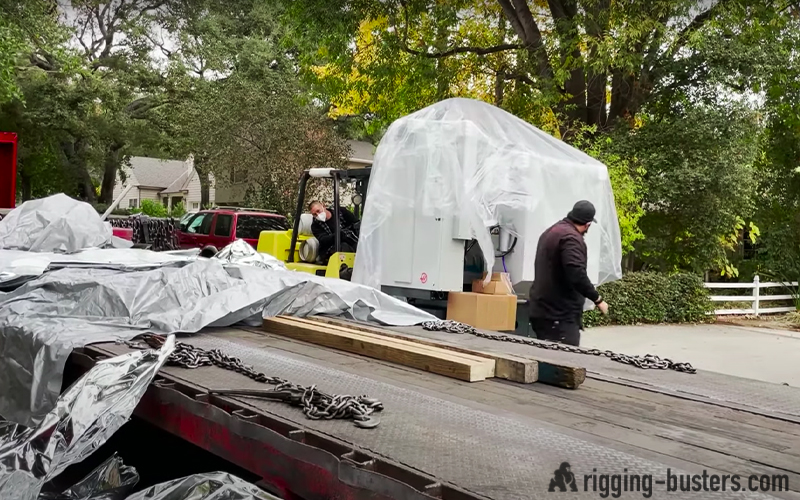
- Crating: wrapping, skids or ISPM 15 crates
- Permits and escorts: for each province and state on the route
- Customs broker fees: paid to your customs broker, not to us
- Distance: the route and the crossing used
- Transfer at the border: on loads into Mexico
- Installation: set-in-place, levelling and millwright work
Projects start at 3,500 CAD, before tax. Duties and import taxes are separate and are paid by the importer of record. Send the machine list with your quote request and the quote lists each item. Our pricing page shows how jobs are priced.
Where Cross-Border Moves Start and End
Ontario and Quebec: Windsor-Essex, London and St. Thomas, the GTA, Hamilton and Niagara, Kitchener-Waterloo and Cambridge, Kingston and Brockville, Ottawa, Montreal and the rest of Quebec.
United States and Mexico: Michigan, Ohio, New York, Pennsylvania and Texas; Nuevo León, Coahuila, Tamaulipas and the Bajío.
Near Detroit, see Windsor, machinery movers in Windsor and auto and EV plant rigging in Windsor; in Quebec, Montreal; within Ontario, machinery movers in Ontario.
or give a call +1-647-846-5179
Why Plants Use Us for Cross-Border Moves
- One plan and one quote from rig-out to set-in-place.
- Machine data from the survey, ready for customs.
- Permits and bridges booked for the whole route.
- ISPM 15 crating for Mexico, confirmed in the quote.
- One crew from rigging to millwright installation.
- Quick answers: quotes within 2–4 business hours.
Send These for a Fast Quote
Send these with your quote request for a quote without guesswork:
- Machine list: make, model, serial number, weight and dimensions, with photos
- Both addresses: with doors, docks, floors and site hours
- Dates: shutdown, arrival and start-up
- Customs contacts: the importer of record and the customs broker on each side
- Packing: whether crating is needed at the destination
- Scope: haul only, or set-in-place, levelling and installation too, and any storage
- Trades: who disconnects and reconnects, and whether the maker commissions
Other Services in Ontario and Quebec
Related services for moves on either side of the border:
- Machinery & Heavy Equipment Transport in Ontario
- Auction Machinery Removal in Ontario
- Heavy Equipment Loading, Unloading & Crating in Toronto, ON
- Millwright Services & Machinery Installation in Toronto, ON
- Factory & Plant Relocation in Toronto, ON
- Factory & Plant Relocation in Montreal, QC
Cross-Border Machinery Moving: FAQ
Your customs broker clears the machine for the importer of record; in Mexico, an agente aduanal usually files the pedimento. We give your customs broker the machine data from our survey (make, model, serial number, weight and size) and time the move to their filings.
In practice, yes. A US importer may file its own entries, but many use a licensed customs broker, and a Canadian company acting as US importer of record also needs a resident agent and a bond.
Yes, for solid wood that travels with the machine: crates, skids and blocking must be heat-treated or fumigated and carry the IPPC mark under NOM-144-SEMARNAT-2017; plywood and other processed wood are exempt. Packaging that fails the check must be treated or sent back.
It depends on the machines, the permits and the paperwork, so you get a dated plan rather than a guess. Known lead times include at least 5 business days for an Ontario single-trip permit and 24 hours’ notice to the bridge for an oversize crossing. Large plants can move in phases.
Yes, into Ontario or Quebec: we rig it out, haul it across and set it in place at your plant. As the importer, you need a CARM Client Portal account, a business number and an import account.
Yes. One crew handles rigging, transport, set-in-place, levelling and millwright installation. Your licensed electricians reconnect power, and your team or the maker commissions the machine. See our millwright and installation services.
The importer of record. In the US, duties stay the importer’s debt until CBP is paid, even if you paid your customs broker; in Canada, GST is charged on the value plus duty. Your customs broker confirms the amount before the move.
A permit from every state on the route; there is no federal permit. Each one sets the route, the travel days and hours, and the escorts. Border bridges add their own notice and hours rules.
Yes. Machines can be wrapped, skidded or crated, and stored until the paperwork, the permits or the new building are ready. ISPM 15 crating for Mexico is confirmed in the quote, and storage is priced into it.
It is priced per project: weight and size, crating, permits, escorts, distance, transfer at the border and installation set the price. Projects start at 3,500 CAD, before tax; customs broker fees, duties and import taxes are separate. Send the machine list with the quote request form.