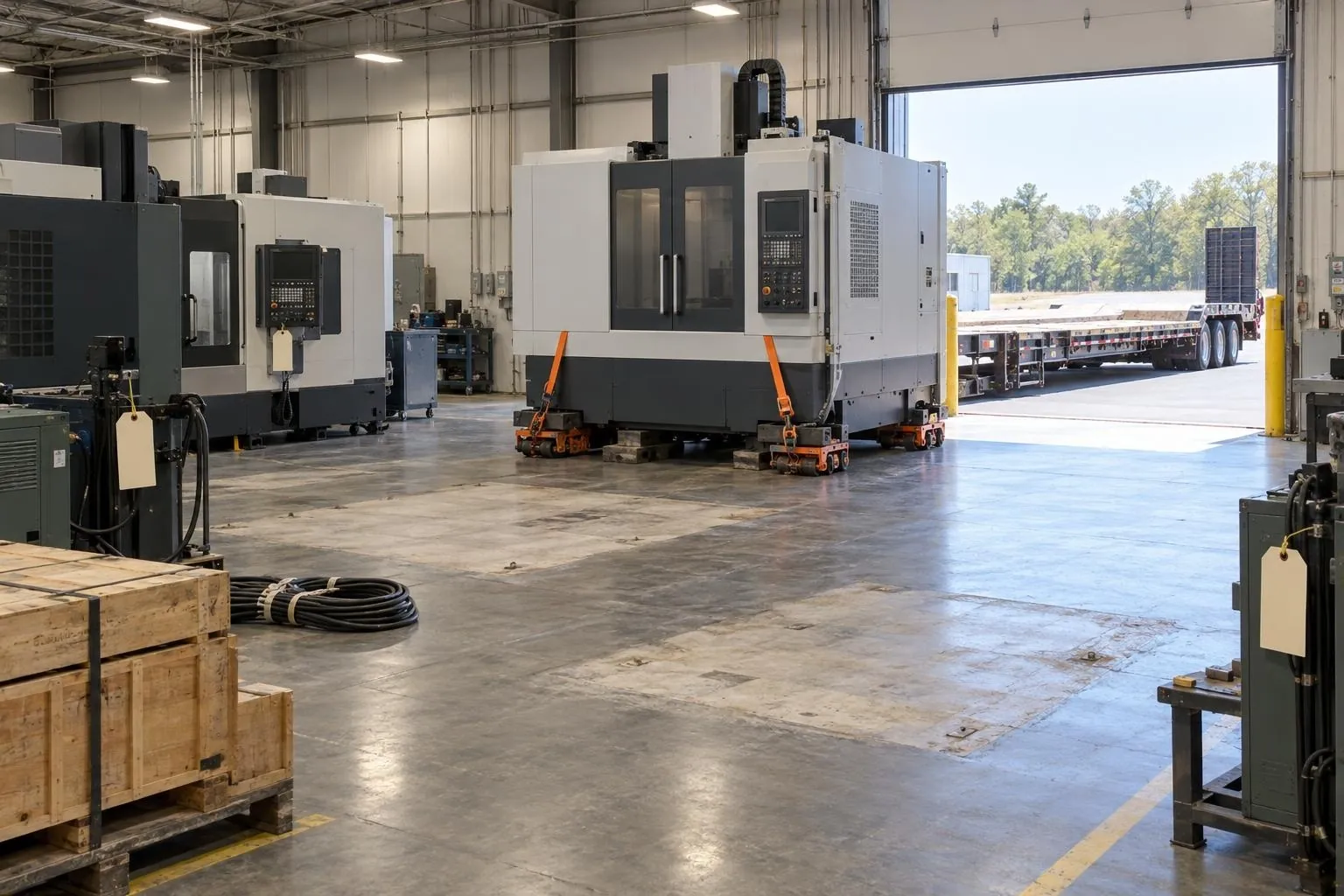
Bought machines at a plant auction or a receiver’s sale in Ontario? Rigging-Busters plans each removal to finish inside the removal window. We check the sale’s removal terms, send the paperwork the auction house asks for, rig each machine out, then load, secure and haul it. At the other end we set it in place in your plant, or store it until your building is ready.
We work for the people who buy at industrial auctions: manufacturers adding capacity, machinery dealers and rebuilders, exporters and integrators. Typical lots are CNC machining centres and lathes, presses and press brakes, injection moulding machines, fabrication and packaging equipment, compressors and plant utilities.
- Industrial only: machines and plant equipment. No household moves, scrap removal or equipment buying.
- Inside the window: removal by appointment, within the sale’s dates and the site’s hours.
- Paperwork before removal day: the certificate of insurance, workers’ compensation proof and rigger release, checked against your sale’s terms when we quote.
- Minimum job: 3,500 CAD. A single heavy machine is a good fit; small lots are best combined into one removal.
- Quick replies: quotes within 2–4 business hours, and estimates are free.
- Insured: liability and workers’ compensation insurance (WSIB in Ontario), with a certificate of insurance on request.
Want a budget figure before the sale closes? The Heavy Lifting & Moving Calculator gives a rough price range in a few minutes.
or give a call +1-647-846-5179
Before You Bid: Check the Removal First
A cheap lot can become an expensive one if it can’t come out in time. Send us the lot links before the sale closes and we check:
- Weight and size: weight and dimensions from the manufacturer’s data for the make and model, not a guess from the catalogue.
- The way out: door and dock sizes, floor capacity, overhead lines, and where a trailer can stand.
- The removal window: the dates, the site hours, and whether removal is by appointment only.
- Exclusive rigger: some sales name one rigger for some or all lots. If yours does, only that rigger can rig them out; we tell you before you bid and, where the terms allow, take over at the dock for the haul and set-in-place.
- Disconnects: who cuts power, gas, air and water, and whether oil and coolant must be drained.
- Where it goes: straight to your plant, into storage, or onto a truck you have booked.
You get a clear answer and a budget range, so you can bid with the removal cost in mind.
The Paperwork Auction Houses Ask Riggers For
Ontario auction houses publish removal terms with every sale, and the rigger must meet them before touching a lot. The usual requirements are:
- Certificate of insurance naming the auction house, and sometimes the seller, as additional insured. Each sale sets its own limit; Ontario terms we have checked ask for $2 million or $5 million.
- Workers’ compensation: proof of WSIB coverage, often a clearance certificate.
- Rigger release: the buyer’s written authorization for the rigger to remove the lots, sometimes with a site-access or indemnity agreement.
- A paid invoice: lots are released only once they are paid in full.
- Booked appointments: removal only in agreed slots, during the site’s weekday hours.
We read the terms for your sale, tell you in the quote whether each requirement, including the insurance limit, can be met, and send the documents before removal day. Paperwork that arrives late can cost you a removal slot.
How an Auction Removal Runs
Every auction removal follows the same seven steps, whether it is one heavy lot or a trailer load of machines:
- Lot list: lot numbers, catalogue photos, your invoice and the removal deadline.
- Terms and site check: the sale’s removal rules, the building’s access and the trades needed for disconnects.
- Paperwork: certificate of insurance, workers’ compensation proof and the rigger release, sent to the auction house.
- Booking: removal slots agreed with the site, with the heavy lots scheduled first.
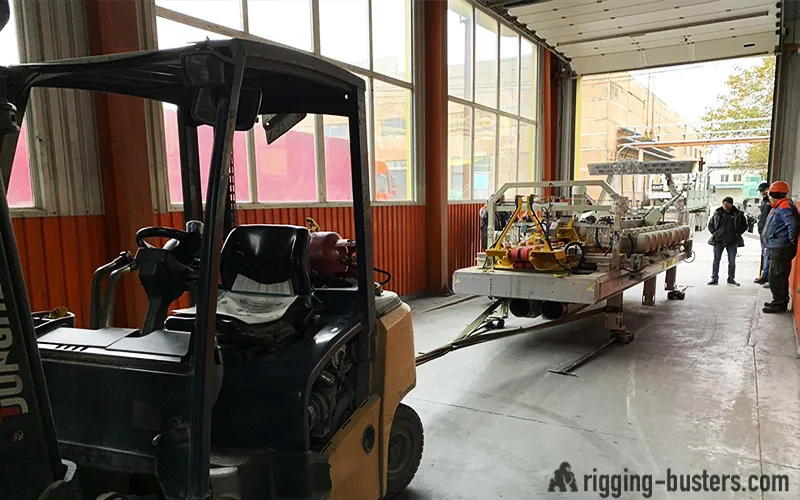
- Rig-out: machines lifted off their anchors and moved out on skates, jacks, gantries or a forklift of the right capacity.
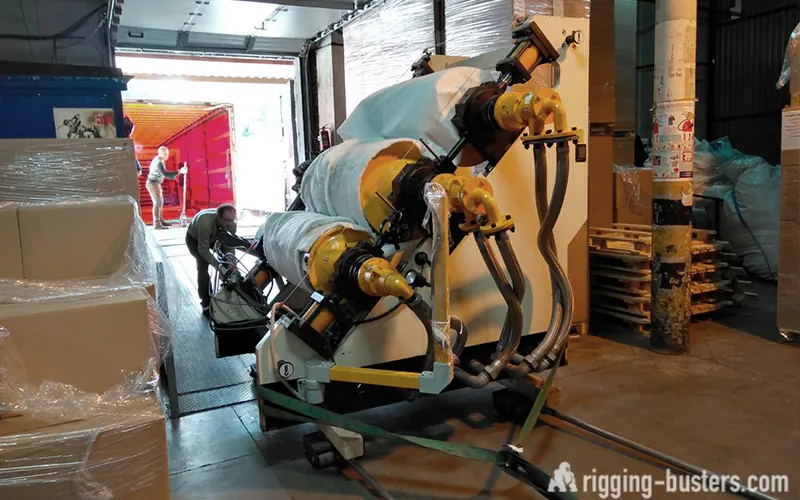
- Load-out: machines loaded and secured on the right trailer, with sensitive parts wrapped for the road.
- Delivery: hauled under the permits the load needs, then set in place at your plant, or stored until you are ready.
Disconnects, Fluids and Anchors
Power, gas, compressed air and water are disconnected to code by qualified trades (a licensed electrician for power, a licensed gas fitter for gas), arranged by you or as the sale terms require. Hydraulic oil and coolant are drained where the machine manual or the site rules call for it. Where the sale terms ask for it, anchor bolts are cut flush with the floor and the holes made safe, so the building is left the way the seller and the landlord expect. Our riggers take it from there.
or give a call +1-647-846-5179
Removal Windows and Deadlines
Removal windows are short. Ontario plant sales often give buyers only one to two weeks after the auction closes, sometimes up to four, by appointment and during site hours. Under many sale terms, lots left after the deadline go back to the seller or are resold, and the buyer can still be charged for any shortfall and storage.
Book early: crews and trailers fill up when several sales close in the same month, and heavy lots often have to come out before the lots around them can be reached.
Several Lots, One Plan
Many buyers win more than one lot. We plan them as one removal, in the order the floor allows, and load them onto as few trailers as the weights and sizes permit. If you bought at two sales in the same area, tell us: both can often be covered in the same trip.
What We Remove, and What We Don’t
Lots We Take
- CNC machining centres, lathes, grinders and other machine tools
- Presses, press brakes, shears and coil-processing lines
- Injection moulding machines with their robots and auxiliaries
- Fabrication and welding equipment, laser and plasma tables
- Food, packaging and converting lines
- Compressors, generators, transformers and other plant utilities
Not a Fit
Single small lots under our 3,500 CAD minimum (hand tools, benchtop machines, office furniture), scrap and metal recycling, buying or appraising equipment, and running the auction itself.
For Auction Houses, Receivers and Sellers
Auction houses, receivers and trustees need a rigger who meets the sale’s insurance and safety terms, works to the removal schedule and leaves the building as the landlord expects. We can take the heavy lots for several buyers at one sale, or rig out and load the machines left after the buyers’ removals.
For a whole-plant clear-out with a lease or closing deadline, see plant removal and decommissioning in Hamilton and industrial equipment removal in Toronto. Send us the catalogue and the removal terms, and we confirm what we can cover before the auction opens.
After Load-Out: Delivery, Set-In-Place or Storage
Most auction machines go straight to the buyer’s plant. We haul them under the permits they need, then set them in place, ready for levelling, anchoring and connection; see machinery transport in Ontario and millwright services and machinery installation. If your building isn’t ready, the machines can be stored between sites.
Loads bound for Quebec are planned the same way. Moves to the United States are quoted case by case.
What an Auction Removal Costs
Auction removals are priced per job, once we know the lots and both sites. The price depends on:
- The lots: how many, and their total weight
- Rigging: skates, jacks, a gantry, a heavy forklift or a crane, depending on the lot
- Access: doors, docks, floors and stairs at the sale site and at your plant
- The window: tight deadlines, and evening or weekend work where the site allows it
- The haul: distance, trailer type and any oversize permits
- Extras: anchor cutting, disconnect coordination and storage, if needed
Jobs start at 3,500 CAD, so single small lots rarely make sense on their own, and combining lots does. For a rough range, try the Heavy Lifting and Moving Calculator, or see how jobs are priced on our pricing page.
Areas We Cover in Ontario
We remove lots from plant sales across Ontario: the GTA (Toronto, Mississauga, Brampton, Vaughan and Concord, Markham, Oakville), Hamilton, Burlington and Niagara, Brantford, Kitchener-Waterloo, Cambridge and Guelph, London and Windsor, Oshawa and Durham Region, Barrie, Kingston and Ottawa.
For other moves in one city, see machinery movers in Toronto, Mississauga, Brampton, Hamilton, Brantford, Kitchener-Waterloo, London, Windsor, Oshawa and Ottawa.
or give a call +1-647-846-5179
Why Buyers Use Us at Ontario Auctions
- The removal checked before you bid, so the price of getting the lot out is known.
- Paperwork ready before removal day: certificate of insurance, workers’ compensation proof, rigger release.
- Riggers at both ends, from rig-out at the sale to set-in-place at your plant.
- Heavy lots planned first, inside the deadline.
- One quote for removal, haul and set-in-place.
- Quick answers: quotes within 2–4 business hours.
Send These for a Fast Quote
Send these with your quote request and we can price the removal without guesswork:
- The sale: the auction house and the sale page or catalogue link
- Your lots: lot numbers, photos, make and model, and weights if known
- Removal terms: the deadline, site hours, insurance limits and any exclusive-rigger notes
- Pickup: the sale address and the site contact
- Destination: your plant, storage or a carrier you have booked, and the access at that end
- Disconnects: who handles power, gas, air, water and fluids
- Your dates: when you can receive the machines
Other Services in Ontario
Browse all our services in Canada, or go straight to a related service:
- Machinery & Heavy Equipment Transport in Ontario
- Industrial Plant Removal & Decommissioning in Hamilton, ON
- Industrial Equipment Removal & Disposal in Toronto, ON
- Heavy Equipment Loading & Unloading in Toronto, ON
- Millwright Services & Machinery Installation in Toronto, ON
- Industrial Rigging Services in Toronto, ON
- Machinery & Heavy Equipment Movers in Ontario
Auction Machinery Removal in Ontario: FAQ
It is priced per job: the number of lots and their weight, the rigging each one needs, access at both sites, the removal window and the haul set the price. Jobs start at 3,500 CAD, so combining several lots in one removal usually gives better value. For a rough range, use our Heavy Lifting and Moving Calculator.
It depends on the sale. Many Ontario sales let buyers bring their own rigger if the rigger meets the removal terms. Some name an exclusive rigger for some or all lots, and then only that rigger can rig them out; where the terms allow, we can still take over at the dock for the haul and set-in-place. Check the terms before you bid, or send us the sale link and we check them for you.
A certificate of insurance naming the auction house, and sometimes the seller, as additional insured, plus proof of workers’ compensation (WSIB) coverage. Each sale sets its own liability limit; Ontario terms we have checked ask for $2 million or $5 million. Send us the terms and we confirm in the quote whether our certificate meets your sale’s limit.
It is the buyer’s written authorization for a named rigger to remove the lots they bought. Auction houses ask for it, with a paid invoice, before they release a lot to anyone but the buyer. Some sales also ask the rigger, the buyer and the seller to sign a site-access or indemnity agreement. We give you the exact company name to put on your release.
Often only one to two weeks after the sale closes, sometimes up to four, by appointment and during the site’s weekday hours. The exact deadline is in the sale terms and on your invoice. Under many terms, lots left after the deadline go back to the seller or are resold, and you can still be charged for any shortfall and storage, so book the removal as soon as you know you won.
Yes. Send the lot links before the sale closes, and we check the weight and size from the manufacturer’s data, the way out of the building, the removal window, any exclusive-rigger rule and who handles the disconnects. You get a clear answer and a budget range, so you can bid with the removal cost in mind.
Licensed trades: the sale terms say who is responsible, and usually the buyer arranges a licensed electrician for power and a licensed gas fitter for gas, plus plumbing or air disconnects where needed. Oil and coolant are drained where the manual or the site rules call for it. Our riggers then lift the machine off its anchors and move it out.
Not on their own if the job comes in under our 3,500 CAD minimum, as with hand tools or benchtop machines. Single heavy machines and groups of lots are a good fit. If you won several lots, send them together and we plan one removal for all of them.
Yes. If your building isn’t ready by the removal deadline, the machines can be loaded out on time and stored between sites, then delivered and set in place when you are ready. Tell us the dates in your quote request, and storage is priced into the quote.
Quebec deliveries are planned the same way as moves within Ontario. Moves to the United States are quoted case by case. For the full list of what we need, see the checklist on this page, then send your lots with the quote request form.