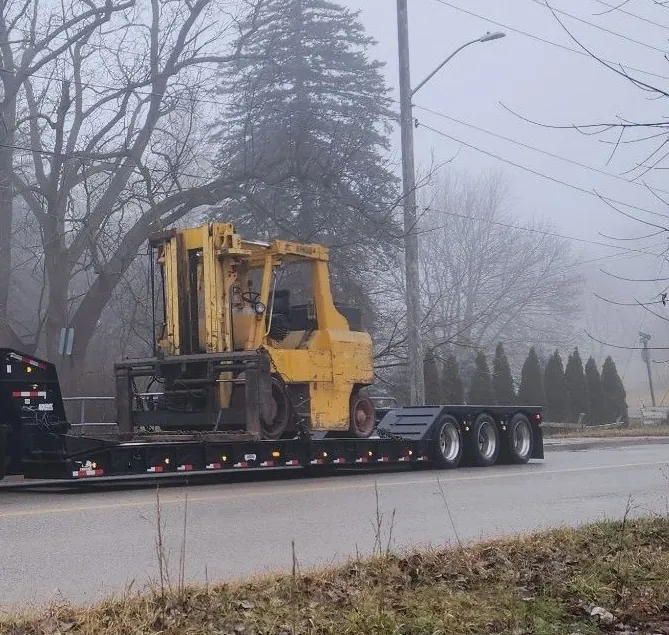
Need an excavator, a dozer, a crusher or a combine moved, and it is too wide, tall or heavy for an ordinary trailer? Rigging-Busters plans construction and farm equipment transport across Ontario as one job: the right float, the oversize permits and escorts, and riggers to load, chain down and unload it, so the machine arrives ready to work.
We are a machinery moving and rigging company with professional riggers and lifters, set up for permitted loads, long runs, several machines at once, and machines that must be winched, lifted or taken apart.
- Construction and farm equipment: excavators, dozers, loaders, crushers, tractors and combines. No towing or car hauling.
- Permits and escorts arranged: MTO and municipal permits, pilot vehicles and travel times planned before the move.
- Minimum job: 3,500 CAD. Oversize loads, long hauls and multi-machine moves clear it; a single short local float run usually does not.
- Quick replies: quotes within 2–4 business hours, and estimates are free.
- Equipment: jack-and-roll systems for loads up to 600 tons, hydraulic gantries, lift trucks up to 60,000 lb and float trailers for loads up to 50 tons.
- Insured: liability and workers’ compensation insurance (WSIB in Ontario), with a certificate of insurance on request.
Send the machine and both addresses, and your quote names the trailer, the permits and the price.
or give a call +1-647-846-5179
Who Hires Us to Haul Heavy Equipment
We haul for four kinds of buyers:
- Contractors: a whole job’s equipment moved to a new project or yard, or a wide or heavy machine moved between distant sites.
- Equipment dealers and buyers: new and used machines delivered, including auction purchases. For lots in a plant sale, see auction machinery removal in Ontario.
- Farms and farm-equipment dealers: combines, large tractors and tillage equipment, or a farm’s machinery moved to a new property.
- Municipalities and utilities: several graders, loaders or backhoes moved in one plan, or over long distances.
Machines We Haul, and the Trailer Each One Needs
The trailer depends on the machine’s transport height, width and weight, and on how it gets on board; machines over 50 tons are quoted case by case:
- Excavators: lowboy or RGN, boom down and bucket curled in; very heavy machines go in sections.
- Dozers: lowboy. A wide blade can push the load past 2.6 m and may ride separately.
- Loaders, graders and backhoes: lowboy, RGN or step-deck, by height.
- Crushers and screening plants: RGN or multi-axle lowboy, often on a permit.
- Combines and large tractors: lowboy or RGN, the header on its own trailer and the duals off if needed.
- Skid steers and compact excavators: only as part of a larger move.
Float, Lowboy, RGN or Step-Deck?
In eastern Canada a lowboy is often called a float, and MTO’s permit guide speaks of float-type trailers.
- Lowboy (float): a low main deck between the gooseneck and the rear axles, so tall machines ride lower; also called a low-bed or double-drop.
- RGN (removable gooseneck): the neck comes off and the front of the deck lowers to the ground, so the machine drives on from the front.
- Step-deck: a raised front section and a lower rear deck; with ramps, wheeled machines drive on.
- Multi-axle trailers: extra axles spread the weight, because Ontario sets weight limits by axle configuration and spacing.
How a Heavy Equipment Haul Runs
The sequence is the same for one dozer or a whole yard:
- Machine details: make, model, weight and transport dimensions.
- Route check: the load against the legal limits, then the roads, bridges, turns and overhead lines.
- Trailer and truck: matched to the height, the weight and how the machine loads.
- Permits and escorts: MTO permits for provincial highways, municipal permits for local roads, pilot vehicles where required.
- Loading: driven, winched, rolled or lifted aboard, with attachments lowered.
- Chaining down: to the national standard, re-checked within the first 80 km.
- Delivery: unloaded and placed where you need it, or set on its foundation if it is fixed plant.
How a Machine Is Chained to the Trailer
Ontario enforces NSC Standard 10, the national cargo securement standard, through O. Reg. 363/04. For equipment on wheels or tracks over 4,500 kg, it requires:
- at least four tiedowns, each rated for 2,268 kg or more, at the front and rear or on the machine’s tie-down points;
- attachments such as buckets, blades and booms lowered and secured, or blocked;
- articulated machines, such as wheel loaders, locked so they cannot bend;
- tiedowns rated, together, for at least half the machine’s weight.

or give a call +1-647-846-5179
Oversize Permits, Escorts and Travel Times in Ontario
When the Load Needs a Permit
The Highway Traffic Act allows a vehicle and its load up to 2.6 m wide, 4.15 m high and 23 m long as a truck and trailer (12.5 m for a single vehicle), within set axle and gross weights. Past those limits the haul needs a permit, issued only for a load that cannot reasonably be divided. MTO permits cover King’s highways only; city, regional and county roads need their own.
MTO Single-Trip and Annual Permits
- Single-trip permit: one route, one way, valid up to 7 days, with a current turnaround of 5 business days. Up to 5 m wide, 45.75 m long and 120,000 kg (weight subject to approval); over 4.26 m high, a low-profile trailer is required.
- Annual permit: 12 months of repeat moves up to 3.85 m wide on multi-lane highways (3.7 m on two-lane), 25 m long, 4.26 m high and 63,500 kg; up to 15 business days to issue, so apply 30 days ahead.
- Superload: over 5 m wide, 45.75 m long or 120,000 kg; superload escorts, a traffic management plan, bridge evaluation over 120,000 kg, and more time.
- Fees: $66.25 oversize only; overweight $127.50 (up to 100 km), $204 (101 to 500 km) or $265.25 (over 500 km); superload $714.
Escorts by Load Size
| Load on a provincial highway | Escort vehicles |
|---|---|
| Up to 3.99 m wide | None for width |
| 4.00 to 4.59 m wide | 1, on multi-lane and two-lane highways |
| 4.60 to 4.99 m wide | 1 on multi-lane highways, 2 on two-lane highways |
| 36.76 to 45.74 m long | 1 |
| Rear overhang over 4.65 m | 1, behind the load |
| 4.87 m high or more | 1 pole car |
| 5 m wide or more, or 45.75 m long or more | Superload escorts |
When Oversize Loads Can Travel
- At night: up to 3.05 m wide and 25 m long on multi-lane controlled-access highways with a median, or up to 4.26 m high and 63,500 kg; larger loads move by day.
- Summer: from June to August in Southern Ontario, no overweight travel from Sunday noon to midnight, and Friday travel from 3:00 p.m. to midnight only up to 4.26 m high and 63,500 kg.
- Statutory holidays: loads within annual-permit sizes move only from half an hour before sunrise to noon; larger loads stay parked, and travel only until noon the day before.
- GTA rush hours: permit loads over 3.85 m wide (3.7 m on two-lane highways), 25 m long, 4.26 m high or 63,500 kg are restricted in the GTA from 7:00 to 9:30 a.m. and 3:30 to 6:30 p.m.
Spring Load Restrictions
In a spring reduced load period, set by MTO and by municipal by-law, designated roads allow no more than 5,000 kg on any truck or trailer axle; Chatham-Kent and Haldimand County, for example, apply it from March 1 to April 30. MTO’s annual and project overweight permits are not valid on King’s highways in March and April in Southern Ontario, and single-trip moves on reduced-load highways need MTO approval. Spring deliveries to farms and rural sites may need a longer route or a later date.
Combines and Tractors: Driven or Hauled?
Driven on the road, an over-dimensional farm vehicle is exempt from the Act’s size and weight limits, but Regulation 603 bars it from most 400-series highways and the QEW. On a truck and trailer it is ordinary cargo: MTO’s farm guide calls for a permit above 2.6 m wide, 23 m long, 4.15 m high or the legal weights.
Long Hauls: Across Ontario, Into Quebec and to the US
Long hauls are planned around permits, travel windows and escorts, so the machine arrives when the site can take it. Into Quebec, an oversize or overweight load needs a special travel permit from Quebec’s Ministère des Transports et de la Mobilité durable (Highway Safety Code, art. 463). A specific permit covers one route and the return for up to 7 consecutive days. A general Class 1 permit allows up to 4.40 m wide and 4.30 m high, a specific one up to 5 m. Allowed loads drop during Quebec’s spring thaw.
In the United States, each state on the route issues its own permit; the federal government issues none. Cross-border hauls are quoted case by case. See cross-border machinery moving.
Loading, Unloading and Dismantling for Transport
A float is easy when the machine drives on. When the engine will not start, a track is off or a crusher or screen has no drive, our riggers winch, jack and roll, or lift it aboard with gantries, a heavy lift truck or a crane.
Dismantling often decides the permit: Ontario issues permits only for loads that cannot reasonably be divided, so a bucket, blade or header that comes off readily may have to travel separately. Taking parts off can also bring the load within 2.6 m wide and 4.15 m high and avoid a permit. We tag, pack and refit the parts on site.
Loading or unloading at one site only? See heavy equipment loading and unloading in Toronto, Ottawa and Windsor.
What Changes the Price, and What We Don’t Take
Each haul is priced per job, once we know the machines and both sites. The price depends on:
- Size and weight: the trailer, the axle set-up and the permit class.
- Distance and route: kilometres, and detours around weak bridges and restricted roads.
- Permits and escorts: MTO and municipal permit fees, and pilot vehicles.
- Loading: drive-on, or winching, lifting and dismantling.
- Timing: spring limits, holiday and rush-hour windows, and waiting time.
- Several machines: one plan shares the route check, the permits and the trip to site.
Jobs start at 3,500 CAD per project, before tax. Permitted loads, long hauls and multi-machine moves usually clear it; a single short local float run typically costs less, so it is not a fit, and a local float operator will serve you better. See how jobs are priced on our pricing page.
Not a Fit
Towing and roadside recovery, equipment rental (we do not rent out floats or machines), single local hauls under the 3,500 CAD minimum, scrap, and cars and other personal vehicles.
Areas We Cover in Ontario
We haul heavy equipment across Ontario: the GTA (Toronto, Mississauga, Brampton, Vaughan, Oakville and Durham Region), Hamilton and Niagara, Brantford, Kitchener-Waterloo, Cambridge, Guelph, London, Windsor, Chatham-Kent, Barrie, Peterborough, Kingston and Ottawa, plus the farms and rural sites in between. We also take long hauls to Northern Ontario: Sudbury, North Bay, Sault Ste. Marie, Timmins and Thunder Bay, with travel priced into the quote.
For other services in one city, see our pages for Toronto, Hamilton, London, Windsor and Ottawa.
or give a call +1-647-846-5179
Why Buyers Call Us for Heavy Hauls
- Riggers, not just a driver, for machines that will not drive on or must come apart.
- Permits, escorts and travel windows planned before the move.
- One crew for rigging, transport, set-in-place, levelling and millwright installation of fixed plant.
Send These for a Quote in 2–4 Business Hours
Send these with your quote request and we can price the haul without guesswork:
- The machines: make, model and year of each one, with photos.
- Weight: operating weight with the attachments it travels with.
- Transport size: length, width and height, with bucket, blade, header or duals.
- Both addresses: pickup and delivery, with a site contact at each.
- Site access: ground, gates, turns and overhead lines at both ends.
- Site rules: any insurance certificate or WSIB clearance either site requires.
- Does it run? Whether it drives, steers and brakes.
- Dates: when it is ready, when it is needed, and any deadline.
Other Services in Ontario
Go straight to a related service:
- Rigged Machinery Transport in Ontario
- Machinery & Heavy Equipment Movers in Ontario
- Heavy Equipment Loading & Unloading in Toronto, ON
- Heavy Equipment Loading & Unloading in Ottawa, ON
- Heavy Equipment Loading & Unloading in Windsor, ON
- Auction Machinery Removal in Ontario
- Cross-Border Machinery Moving (USA and Mexico)
Heavy Equipment Transport in Ontario: FAQ
It is priced per job: size and weight, the trailer, the distance, permits and escorts, and loading set the price. MTO’s single-trip fees are $66.25 to $714. Our jobs start at 3,500 CAD before tax.
Only if the truck, trailer and machine together exceed the Highway Traffic Act limits: 2.6 m wide, 4.15 m high, 23 m long, or the legal axle and gross weights. MTO permits cover provincial highways; municipal roads need their own permit.
Allow one to two weeks. MTO’s current single-trip turnaround is 5 business days, and superloads take longer. Municipal permits and escorts can add time, so send the details as soon as you know your dates.
On provincial highways, no escort is needed for width up to 3.99 m. From 4.00 to 4.99 m, one escort is needed on multi-lane highways; on two-lane highways, one up to 4.59 m and two from 4.60 m. From 5 m wide, superload escorts are required.
Yes. In eastern Canada, including Ontario, float is another name for a lowboy: a trailer with a low main deck between the gooseneck and the rear axles. An RGN is a lowboy whose gooseneck comes off, so a machine drives on from the front.
Often, with planning. In a reduced load period, designated roads allow no more than 5,000 kg per axle, on dates each municipality sets (March 1 to April 30 in Chatham-Kent, for example). MTO’s annual and project overweight permits are not valid in March and April in Southern Ontario. We reroute, seek approval or set a later date.
Only off the main routes. Driven, a combine is exempt from the size and weight limits, but Regulation 603 bars it from most 400-series highways and the QEW, and above 4.8 m wide at night it needs an escort in front and behind. For a long run, hauling it on a float is the practical choice, with a permit above 2.6 m wide, 4.15 m high or 23 m long.
Yes. Into Quebec, an oversize or overweight load needs a special travel permit from Quebec’s Ministère des Transports; a specific permit covers one route for up to 7 consecutive days. Each US state on the route issues its own permit. Cross-border hauls are quoted case by case.
Not on its own. A short local float run usually costs well under our 3,500 CAD minimum, so a local float operator is the better choice. Compact machines fit well as part of a larger move. Send the full list with the quote request form.