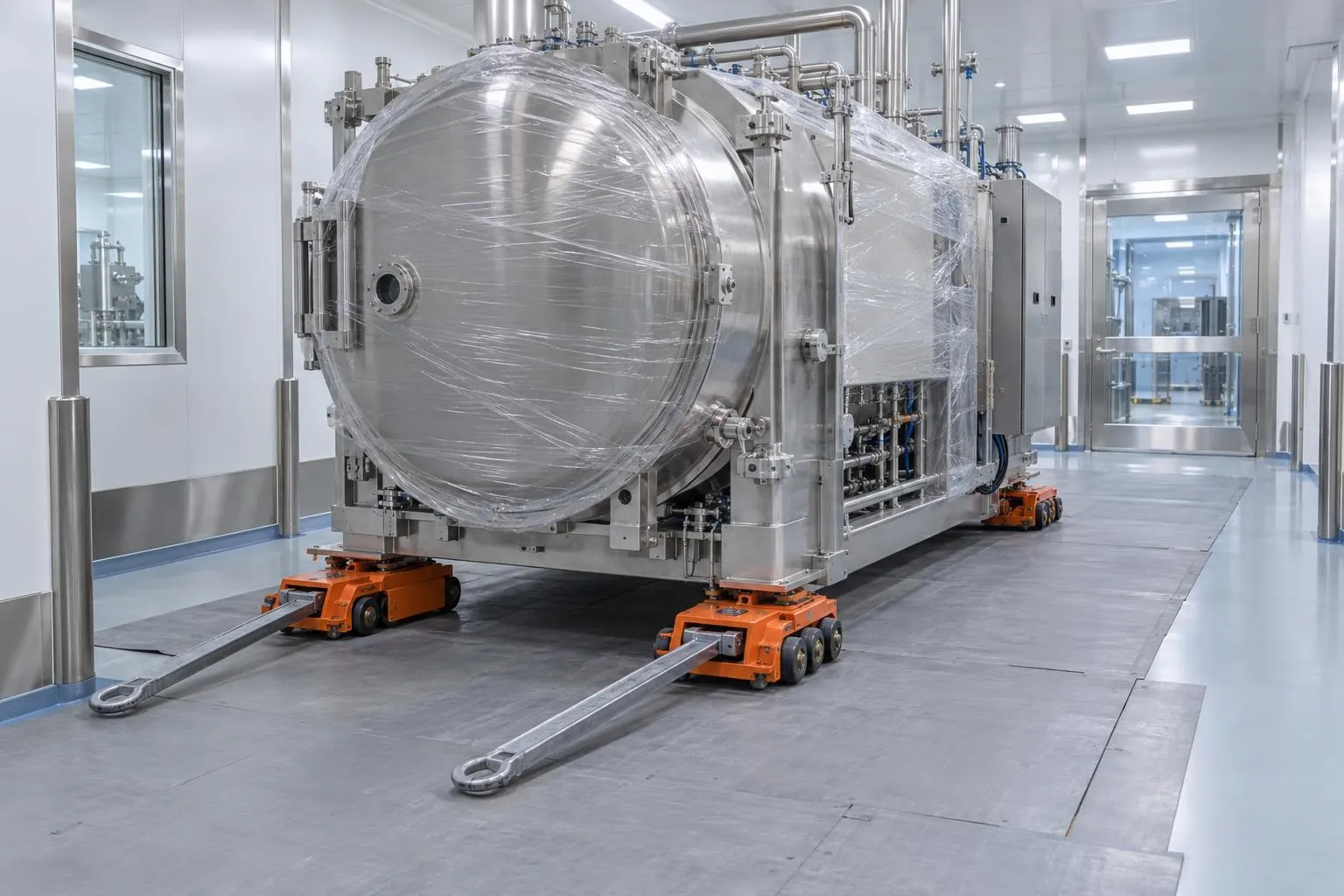
Moving a tablet press, a freeze dryer or a filling line in a GMP plant is a rigging job and a quality event at the same time. Rigging-Busters handles pharmaceutical equipment relocation in Ontario. We plan and carry out the physical move: the route survey, rigging out, protection of the equipment and clean areas, transport between buildings or sites, and set-in-place. Each unit is set in its marked position, ready for your OEM to recommission and your validation team to requalify.
The service is built for pharmaceutical, biotech, vaccine and radiopharmaceutical manufacturers, contract manufacturers (CDMOs), and the engineering firms and equipment makers running their projects. We quote whoever holds the rigging scope, for anything from one isolator moved across a building to a whole line moving to a new site.
- Your change control comes first: the move is planned with your QA and engineering teams, with a written rigging and lift plan.
- Clean-area discipline: equipment wrapped before it leaves its room, skates and tools cleaned, floors protected and your gowning rules followed.
- Written quote: every pharmaceutical move is priced in writing before work starts (minimum job 3,500 CAD).
- Quick replies: we usually reply within 2–4 business hours, and estimates are free.
- Insured: liability and workers’ compensation insurance (WSIB in Ontario), with a certificate of insurance on request.
Need a budget figure for a capital request? The Heavy Lifting & Moving Calculator gives a rough price range in a few minutes.
or give a call +1-647-846-5179
Pharmaceutical Equipment We Move
Pharma equipment is heavier and more delicate than it looks, and much of it was qualified where it stands. Typical moves:
- Tablet presses and compression machines: a production press is compact but dense; the KORSCH XL 400 weighs 4,300 kg net (KORSCH).
- Freeze dryers (lyophilizers): on GEA’s LYOVAC FCM production range, the chamber and condenser alone weigh 12.5 to 20 t empty (GEA).
- Isolators and restricted access barrier systems (RABS): tall, glazed and top-heavy; the working chamber of a SKAN PSI-L isolator weighs about 1,950 kg (SKAN).
- Sterilizers and washers: autoclaves, depyrogenation tunnels, glassware and parts washers.
- Solid-dose process equipment: granulators, fluid-bed dryers, blenders, mills and coating pans.
- Fill-finish and packaging lines: fillers, cappers, labellers, blister machines, cartoners and case packers, moved module by module.
- Process skids and vessels: bioreactors, mixing and holding tanks, clean-in-place (CIP), purified-water and clean-steam skids.
- QC laboratory equipment: stability chambers, freezers, autoclaves and instruments; see lab and medical equipment movers in Toronto.
How the Move Fits Your GMP Change Control
Health Canada’s Good Manufacturing Practices guide for drug products (GUI-0001) says that equipment used in the critical steps of fabrication, packaging/labelling and testing is subject to qualification. It also says that changes which may affect product quality are validated before they are implemented. Moving qualified equipment can be such a change, so the move runs under your change control. The work is split this way:
- Your QA and validation team: the change record, the decision on requalification (IQ/OQ/PQ) and release of the equipment for use.
- The equipment maker (OEM): decommissioning before the move, then recommissioning, adjustment and calibration at the new position.
- Your engineering team and licensed trades: disconnecting and reconnecting power, compressed air, process and clean utilities, and HVAC.
- Our riggers: route survey, written rigging and lift plan, protection, rigging out, transport and setting the unit in its marked position.
We don’t qualify or validate equipment, clean or decontaminate it, or carry drugs, APIs, chemicals or hazardous waste. Your team drains, cleans and caps each unit and releases it to us as safe to handle. For equipment that ran potent or radioactive products, we ask for that release in writing. We plan our steps around your teams and their licensed contractors.
Moving Production to a New Building
A move into a different building has a licensing step. Health Canada’s Drug Establishment Licence (DEL) guidance (GUI-0002) treats it as a change that needs a DEL amendment before activities start at the new location. The licence holder files it; we set the move dates with your project team so equipment arrives when the new rooms are ready for it.
or give a call +1-647-846-5179
Protecting Clean Areas and Equipment
The equipment has to arrive undamaged, and the rooms it passes through have to stay clean. On a pharmaceutical move we:
- Plan the route with your facility team: corridors, airlocks, material doors, lifts and floor loading from the room to the dock, checked with your building engineer where needed.
- Wrap each unit before it leaves its room, once your team has capped its open ports and connections.
- Clean skates, dollies and tools before they enter, and protect floors, walls and door frames along the route.
- Follow your gowning, entry and cleaning procedures in classified areas, and keep the time spent there short.
- Work around production: moves timed to campaign ends, shutdowns and cleaning, so the rest of the plant keeps running.
Freeze Dryer (Lyophilizer) Relocation
Production freeze dryers are among the heaviest and most sensitive units in a sterile plant, and they often sit behind a wall of the clean area. The chamber and the condenser are often moved as separate modules, and the route may need a removable wall panel, a roof opening or a crane lift. We plan the rigging from the OEM’s drawings, weights and lifting points. Each module stays level on skates or under a lifting beam, and is set in its marked position for the OEM’s reassembly and your requalification. Overhead lifting points in the building are used only where your building engineer confirms the structure can take the load.
When the route runs outside, between buildings or onto a truck, the crane lift and the haul are planned in the same move. See crane rigging and heavy lifting in Toronto and machinery transport in Ontario.
Tablet Presses, Isolators and Packaging Lines
- Tablet presses: moved with the turret and tooling area protected, on skates rated for the load and over plates where the floor needs them.
- Isolators and RABS: glazing protected, the unit kept upright and steady, and doorways and ceilings checked against its height before the move.
- Packaging lines: each module labelled and photographed before it is disconnected, so the line goes back together in order at the new position.
- Skids and vessels: lifted only at their design lifting points, with nozzles and instruments protected.
Pharma and Life Sciences Plants Across Ontario
Ontario has more than 2,000 life sciences firms (45.2% of Canada’s) and about 75,900 life sciences workers (2024), according to Invest Ontario. Recent plant projects, listed as context and not as our clients:
- Sanofi’s Toronto vaccine manufacturing facility opened in 2024; the federal government described it as the largest biomanufacturing facility in Canadian history (Prime Minister of Canada).
- OmniaBio has a $580 million investment in Brampton to advance cell and gene therapy manufacturing (Invest Ontario).
- AtomVie Global Radiopharma plans to invest over $138 million to expand radiopharmaceutical manufacturing in Hamilton (Invest Ontario).
Projects like these bring new equipment in and move older lines out or between sites, and each of those moves needs rigging.
Pharmaceutical Equipment Moving Cost: What Affects the Price
Every pharmaceutical move is priced per project, once we know the equipment and the route. The main cost drivers are:
- The equipment: sizes, weights and how many units or modules move
- Access: airlocks, lifts, wall or roof openings, and whether a crane is needed
- Clean-area work: gowning time, protection and cleaning of tools and the route
- Timing: shutdown windows, evenings and weekends, and waiting time between steps
- Transport: distance, trailers and road permits between buildings or sites
- Storage when the new rooms aren’t ready yet
Jobs start at 3,500 CAD, and pharmaceutical projects usually cost more. For a rough range, try the Heavy Lifting and Moving Calculator, or see how jobs are priced on our pricing page.
Areas We Cover in Ontario
We move pharmaceutical and life sciences equipment across Ontario: Toronto, Mississauga, Brampton, Vaughan and the rest of the GTA, Hamilton, Kitchener-Waterloo, Guelph, London, Oshawa and Whitby, Kingston and Ottawa, and other regions by arrangement.
or give a call +1-647-846-5179
Why Plan Your Pharmaceutical Move With Us
- Rigging planned from the OEM’s data and a route survey, before the move date.
- A written rigging and lift plan for your change record.
- Clean-area discipline: wrapped equipment, clean tools, protected routes.
- Clear roles with your QA team, the OEM and your trades.
- One team plans the whole move: rig-out, transport, storage if needed, and set-in-place.
- Quick answers: we usually reply within 2–4 business hours.
Have These Ready for a Pharmaceutical Move Quote
Send these with your quote request and we can plan and price the move without guesswork:
- The equipment list: make, model, size and weight of each unit, plus the OEM’s handling rules: lifting points, transport locks, tilt and shock limits
- Layouts: the current and new positions, with drawings or photos
- The route: photos of corridors, airlocks, lifts and the dock
- Clean-area rules: room classifications, gowning and entry procedures
- Dates: the shutdown window and the requalification schedule
- Who does what: decommissioning, utility disconnects and reconnects
- Transport conditions: whether the OEM requires shock and tilt indicators, air-ride trailers or heated transport; we confirm in the quote whether and how each is met
- Site rules and paperwork: contractor prequalification, insurance certificate and required limits, WSIB clearance and any training your site requires; we confirm in the quote whether our documents meet them
Other Services in Ontario
Browse all our services in Canada, or go straight to a related service:
- Lab & Medical Equipment Movers in Toronto, ON
- MRI & Medical Imaging Equipment Rigging in Ontario
- LINAC Rigging & Linear Accelerator Moving in Ontario
- Food Processing Equipment Movers in Brampton, ON
- Factory & Plant Relocation in Mississauga, ON
- Crane Rigging & Heavy Lifting in Toronto, ON
- Millwright Services & Machinery Installation in Toronto, ON
- Machinery & Heavy Equipment Transport in Ontario
- Machinery & Heavy Equipment Movers in Ontario
Pharmaceutical Equipment Relocation in Ontario: FAQ
A pharmaceutical equipment move is priced per project: the equipment and its weights, the route and access, clean-area work, timing, transport and any storage set the price. Jobs start at 3,500 CAD, and pharmaceutical projects usually cost more. For a rough range, use our Heavy Lifting and Moving Calculator.
No. The move runs under your change control, and your quality team decides whether and how the equipment is requalified (IQ/OQ/PQ) before releasing it for use. The OEM recommissions it. We move it, and give you the written rigging and lift plan and the move dates for your change record.
Yes, under your rules. We follow your gowning, entry and cleaning procedures and clean skates, dollies and tools before they go in. Equipment is wrapped before it leaves its room, and time in classified areas is kept short. Tell us the room classifications and procedures with your quote request.
A production freeze dryer is moved from the OEM’s drawings, weights and lifting points. The chamber and the condenser are often moved as separate modules, each kept level on skates or under a lifting beam. The route may need a removable wall panel, a roof opening or a crane lift. The OEM reassembles the unit, and your team requalifies it.
It varies widely. Published figures give an idea. The KORSCH XL 400 tablet press weighs 4,300 kg net. The chamber and condenser of a GEA LYOVAC FCM production freeze dryer weigh 12.5 to 20 t empty. The working chamber of a SKAN PSI-L isolator is about 1,950 kg. Send us your OEM data sheets and we plan from the real weights.
Your regulatory team decides what Health Canada needs, case by case. One case is clear in Health Canada’s DEL guidance (GUI-0002). When operations move into a different building, the Drug Establishment Licence must be amended before activities start at the new location. The licence holder files it; we plan our dates around it.
Your maintenance team or licensed trades disconnect and reconnect power, compressed air, process and clean utilities and HVAC, and the OEM handles its own decommissioning and recommissioning. We schedule the rigging between those steps.
Yes. Your team drains and cleans each unit, decontaminates it where needed, caps its open ports and releases it to us as safe to handle. For equipment that ran potent or radioactive products, we ask for that release in writing. We don’t clean or decontaminate equipment ourselves.
Yes. Each module is labelled and photographed, then rigged out, wrapped and loaded for the trip. At the new site, modules are set in order so the line goes back together as it was. Moves can be staged, one line or area at a time, so the rest of the plant keeps running.
Yes. When the new rooms aren’t ready, equipment can be wrapped and stored between sites, then delivered and set in place on the date you need it. Tell us the dates and any storage conditions the OEM requires, and we confirm in the quote whether and how they can be met.
An equipment list with makes, models, sizes and weights, plus the current and new layouts and photos of the route. Add your clean-area rules, the shutdown and requalification dates, and who handles decommissioning and utilities. Send them with the quote request form, and we usually reply within 2–4 business hours. For QC lab instruments, see lab and medical equipment movers in Toronto.