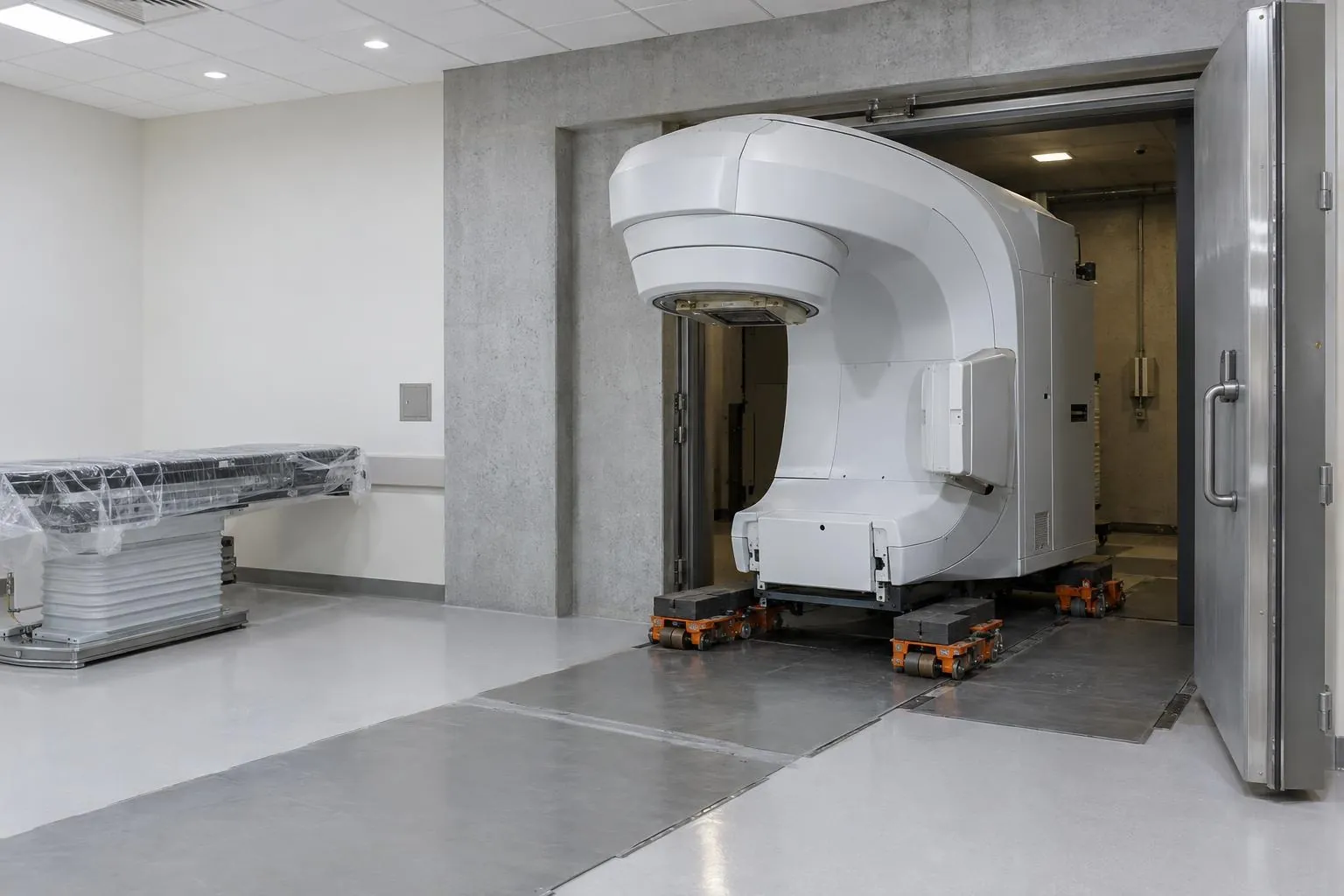
When an Ontario cancer centre replaces or relocates a linear accelerator (LINAC), the old machine has to come out of a shielded treatment vault and the new one has to go in, often inside a tight clinical schedule. Rigging-Busters plans and carries out the rigging: the route through the maze and the vault door, protection of floors and finishes, and the physical move of each section, working alongside the manufacturer’s engineers and the hospital’s physics and facilities teams.
The service is built for radiation-therapy equipment manufacturers and their project managers, hospital capital-project and facilities teams, and the contractors refitting the vault. We quote whoever holds the rigging scope: the hospital, the OEM or the construction manager.
- Clear roles: the manufacturer (OEM) de-installs, installs and calibrates the system; our riggers move it.
- Hospital-ready: protected routes, clean equipment and work planned around treatment days.
- Written quote: every LINAC move is priced in writing before work starts (minimum job 3,500 CAD).
- Quick replies: quotes within 2–4 business hours, and estimates are free.
- Insured: liability and workers’ compensation insurance (WSIB in Ontario), with a certificate of insurance on request.
Need a budget figure for a capital request? The Heavy Lifting & Moving Calculator gives a rough price range in a few minutes.
or give a call +1-647-846-5179
LINAC Jobs We Rig
- Replacement in the same vault: the old unit out and the new unit in, inside the vault refit window.
- Phased replacement programs: one vault at a time, so treatment continues in the others.
- Relocation: machines moved to a new vault or into a new hospital building.
- Removal of a retired LINAC: sections moved out once the hospital has released them, then loaded for the manufacturer, a refurbisher or disposal.
- Related equipment: treatment couches, modulator and control cabinets, CT simulators and other imaging systems; see MRI and medical imaging rigging.
Across Canada, about 15 medical accelerators are taken out of service each year, according to the Canadian Nuclear Safety Commission.
Getting a LINAC Into and Out of a Treatment Vault
A treatment vault is built to stop radiation, not to let machines through. Its walls are thick concrete, the entrance is usually a maze with one or two turns, and some vaults close with a heavy shielding door. The gantry and stand of a LINAC weigh several tonnes and travel in a few large sections, so each section’s route is planned before the move:
- Route survey: door and maze widths, the tightest turn, ceiling height, thresholds and ramps from the loading dock to the vault.
- Floor loading: steel plates or load-spreading boards under the skates, checked against the floor’s capacity.
- Protection: corridors, walls, door frames and new finishes covered along the route.
- Rigging method: low-profile skates, hydraulic jacks and gantries; overhead lifting points only where the building’s engineer confirms the structure can take them.
- Openings: when a section can’t pass the maze, a temporary opening or the removal of shielding blocks is planned with the hospital’s engineers and the vault contractor.
Sections, Weights and the OEM’s Instructions
Manufacturers provide site-planning data for their machines: section sizes, shipping weights, centres of gravity and lifting points. We plan the rigging from that data and the route survey, and move each section the way the OEM’s instructions require.
or give a call +1-647-846-5179
Who Does What on a LINAC Replacement
A LINAC replacement brings several teams into one room. The work is split this way:
- The manufacturer’s engineers: shutdown and de-installation of the old system, installation, alignment and calibration of the new one.
- The hospital’s medical physics and radiation safety staff: surveys of the old machine’s parts before they leave the vault, acceptance testing and commissioning of the new machine, and the licensing steps with the regulator.
- The construction team: the vault refit, electrical, mechanical and shielding work.
- Our riggers: the route plan and protection, moving the old sections out and the new sections in, and setting them where the OEM’s engineers need them.
Are Old LINAC Parts Radioactive?
After years of high-energy treatment, some parts of the treatment head and beamline can be slightly activated. The CNSC describes this activation as generally low and mostly short-lived. Before anything leaves the vault, the hospital’s radiation safety staff, often with the manufacturer, check the parts, and the hospital decides how each one is handled: returned to the manufacturer, sent to a refurbisher, or released for disposal. We move only the parts released to us.
Schedules Built Around Treatment
Patients keep coming while a vault is refitted, so the rigging is planned around the clinic, not the other way around:
- Move days set with the project team, usually inside the planned downtime of the vault being refitted.
- Evenings and weekends for the parts of the route that pass treatment areas or patient corridors.
- Hospital site rules: infection-control measures, access badges, escorts and clean, quiet equipment.
- Delivery timing: the new system brought in when the vault is ready for it, or held until then.
Relocating LINACs to a New Vault or Building
When a hospital moves its radiation therapy into a new building, each LINAC is de-installed by the manufacturer, moved, then installed and recommissioned in its new vault. We plan each machine’s route out of the old vault and into the new one, protect both buildings, and load and secure the sections for the trip between them; see machinery transport in Ontario. Machines move one at a time, so the centre keeps treating patients on the others.
LINAC Replacement Across Ontario
Ontario cancer centres renew their LINACs on a cycle, and several are in the middle of replacement or relocation programs. Public examples, listed as context and not as our clients:
- Niagara Health put the first of three replacement linear accelerators into service in April 2025, with the others to follow year over year (Niagara Health).
- Windsor Regional Hospital opened a fourth radiation vault in March 2025 so its three existing machines could be replaced one by one (Windsor Regional Hospital); local media report that the new machines will later move to the new Fancsy Family Hospital (AM800).
- In December 2025, a tender was posted for a LINAC replacement in Bunker 07 at The Ottawa Hospital’s General Campus (project CP-601).
LINAC Rigging Cost in Ontario: What Affects the Price
LINAC rigging is priced per project, once we know the machines and the route. The main cost drivers are:
- The route: distance from the dock, the maze, doors, ramps and any temporary opening
- Sections and weights: how many pieces move, and the heaviest of them
- Two machines or one: the old unit out and the new unit in, or a single move
- Protection: floor plates, wall and door protection along the route
- Timing: evenings, weekends and waiting time between project steps
- Transport and storage for relocations, or when the vault isn’t ready
Jobs start at 3,500 CAD, and LINAC projects usually cost more. For a rough range, try the Heavy Lifting and Moving Calculator, or see how jobs are priced on our pricing page.
Areas We Cover in Ontario
We rig LINACs and imaging equipment for cancer centres and hospitals across Ontario: Toronto and the GTA, Hamilton and Niagara, Kitchener-Waterloo, London, Windsor, Oshawa and Durham Region, Barrie, Kingston and Ottawa, and other regions by arrangement.
For hospital equipment in Hamilton and Niagara, see hospital equipment rigging in Hamilton; for laboratory moves in the GTA, see lab and medical equipment movers in Toronto.
or give a call +1-647-846-5179
Why Plan Your LINAC Move With Us
- Rigging planned from the OEM’s data and a route survey, before the move date.
- Clear roles with the manufacturer’s engineers and the hospital’s physics team.
- Floors, walls and finishes protected along the whole route.
- Work planned around treatment, including evenings and weekends.
- One crew for the old unit out and the new unit in.
- Quick answers: quotes within 2–4 business hours.
Have These Ready for a LINAC Quote
Send these with your quote request and we can plan and price the move without guesswork:
- The machines: make and model of the old and the new system
- OEM site-planning data: section sizes and shipping weights
- The route: vault and maze drawings, or photos from the dock to the vault
- Dates: the downtime window and the installation schedule
- The old unit: where it goes, and who releases its parts
- Contacts: the OEM project manager and the hospital project lead
- Site rules: infection control, access, WSIB clearance and insurance certificates
Other Services in Ontario
Browse all our services in Canada, or go straight to a related service:
- MRI & Medical Imaging Equipment Rigging in Ontario
- Hospital Equipment Rigging in Hamilton, ON
- Lab & Medical Equipment Movers in Toronto, ON
- Crane Rigging & Heavy Lifting in Toronto, ON
- Heavy Equipment Loading & Unloading in Toronto, ON
- Machinery & Heavy Equipment Transport in Ontario
- Machinery & Heavy Equipment Movers in Ontario
LINAC Rigging in Ontario: FAQ
It is priced per project: the route from the dock to the vault, the number and weight of the sections, whether the old unit comes out as well, protection, timing and any transport set the price. Jobs start at 3,500 CAD, and LINAC projects usually cost more. For a rough range, use our Heavy Lifting and Moving Calculator.
The manufacturer’s engineers. They shut the old system down and de-install it, then install, align and calibrate the new one, and the hospital’s physics team commissions it. Our riggers plan the route and physically move the sections out of and into the vault, setting them where the engineers need them.
With a route survey first: widths, the tightest turn, ceiling height, thresholds and floor capacity from the dock to the vault. The sections then travel on low-profile skates over floor plates, steered and jacked through the turns. If a section can’t pass, a temporary opening or the removal of shielding blocks is planned with the hospital’s engineers.
Parts of the treatment head and beamline can be slightly activated after years of high-energy use; the CNSC describes this as generally low and mostly short-lived. The hospital’s radiation safety staff, often with the manufacturer, check the parts before they leave the vault, and the hospital decides how each is handled. We move the parts released to us.
The gantry and stand of a modern LINAC weigh several tonnes and travel in a few large sections, and the exact figures depend on the make and model. Send us the manufacturer’s site-planning data with your quote request: it gives the size and shipping weight of each section, which is what the rigging plan is built on.
Yes. Move days are set with the project team, usually inside the planned downtime of the vault being refitted, and the parts of the route that pass treatment areas or patient corridors can be done in the evening or on weekends. We follow the hospital’s infection-control, access and escort rules.
Yes. Each machine is de-installed by the manufacturer, rigged out of its old vault, loaded and secured for the trip, then rigged into the new vault for installation and recommissioning. Machines move one at a time, so the centre keeps treating patients on the others.
Yes: MRI magnets, CT and PET-CT gantries, CT simulators, cath-lab and X-ray systems, and hospital plant equipment. See MRI and medical imaging rigging for imaging moves across Ontario.
Usually a certificate of insurance, a WSIB clearance certificate, safety documentation for the task and the hospital’s own site and infection-control rules. Tell us the requirements, including any insurance limit, with your quote request; we confirm in the quote whether our documents meet them and send them before the first site visit.
The make and model of the old and new systems, the manufacturer’s site-planning data, drawings or photos of the route from the dock to the vault, your dates and downtime window, what happens to the old unit, the project contacts and the site rules. Send them with the quote request form, and we usually reply within 2–4 business hours.