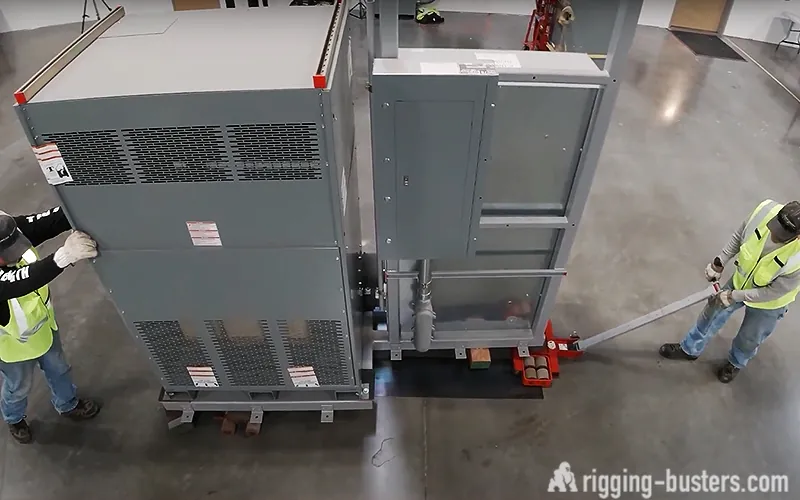
Rigging-Busters moves industrial robots and complete robot cells for plants in Toronto and across the Greater Toronto Area (GTA). Our machinery movers and riggers handle the robot and its pedestal, the controller, guard fencing, conveyors and the machine the robot tends: each piece is moved in the order your integrator needs, then set in place and levelled at the new location.
We do the rigging, transport and set-in-place. Your integrator or the robot maker looks after the programs, calibration and safety sign-off, and we plan the move around their schedule.
- Industrial only: robots, robot cells and plant machinery; no household, office or hobby robots.
- One crew from start to finish: rigging, robot transport, set-in-place, levelling and millwright installation.
- Quick replies: quotes within 2–4 business hours.
- Service area: Toronto, the GTA and southern Ontario (see the areas we cover).
Want a rough number before you brief your integrator? Our Heavy Lifting & Moving Calculator gives an instant price range.
or give a call +1-647-846-5179
How We Relocate a Robot Cell in Toronto
A robot cell only works as a set: the robot, its controller, the safety guarding and the equipment it feeds. We plan robotic cell relocation as one sequence, so each piece comes out, travels and goes back in the right order:
- Survey and photos: robot make and model, pedestal or riser, controller, fence panels, conveyors and the new floor layout.
- Plan with your integrator: the move sequence, the shutdown window and who does each task.
- Backups and lockout: your team saves the programs and calibration data, and your licensed electricians disconnect and lock out power and air.
- Prepare the robot: the arm is put in the transport position from its manual, the axes are secured, and the gripper or end-of-arm tooling comes off.
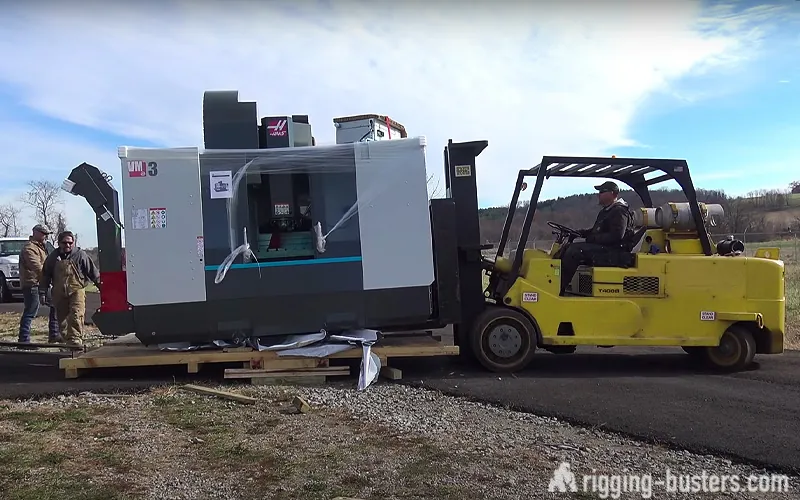
- Rig, skid and load: each piece is lifted only at its rated lifting points and rolled out on skates, a gantry or a forklift.
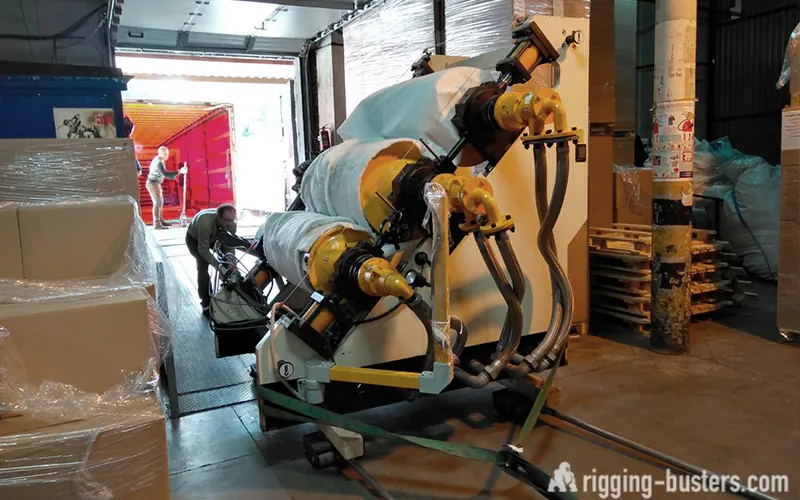
- Robot transport: pieces travel blocked and strapped on a trailer matched to the load, with a permit for anything oversize.
- Set in place and level: pedestal, controller, fencing and conveyors go back on their marks, ready to reconnect and recommission.
Who Does What on a Robot Move
- Your integrator or the robot maker: program and data backups, remastering or calibration, safety checks and the restart.
- Your licensed electricians: disconnecting and reconnecting power and the safety circuits. In Ontario, electrical work done for hire needs a Licensed Electrical Contractor (O. Reg. 570/05).
- Our crew: rigging, skidding, loading, transport, set-in-place and levelling, plus millwright work such as anchoring pedestals and putting fence panels and conveyors back up.
- Your plant: the shutdown window, access at both sites and one contact who signs off each step.
Pre-Start Health and Safety Review in Ontario
A relocated cell is installed again, so leave time for safety checks before it restarts. Ontario’s guideline for pre-start health and safety reviews (section 7 of Regulation 851) lists robots integrated with machines, including a replaced robot, and cobots in cells with electronic safeguards among the equipment that may trigger a review. Your integrator or engineer decides whether one applies and checks the cell against CSA Z434, the Canadian robot safety standard (current edition CSA Z434:26). We set our dates around that work.
Equipment Our Crew Uses
- Machinery skates under pedestals, controller cabinets and conveyor sections
- Hydraulic gantries for lifts where the plant has no overhead crane
- Forklifts sized to the load, using the fork pockets on robot bases that have them
- Trailers matched to each load, with blocking and straps for the trip
- Crane lifts with our crane or a partner crane, for example onto a mezzanine: see crane rigging and heavy lifting in Toronto
Robot Transport and Permits in Toronto
Most single robots and controllers travel within normal size limits. Long robot tracks, big pedestals or a cell shipped on one skid can reach the City’s limits. A truck and load at or above 2.59 m wide, 4.15 m high, 21.33 m long or 50 t needs a City of Toronto single-trip oversize load permit, which normally takes 7 to 10 business days. Oversize loads are kept off the Don Valley Parkway, Black Creek Drive, the Allen Expressway, the elevated section of Lake Shore Boulevard West and the Gardiner east of the Humber, so we route around them. Highways such as the 401 and 427 need an MTO oversize permit, and the province asks for applications at least 5 business days before the trip.
Robots and Automation Equipment We Move
Our crew moves the heavy parts of automation in GTA plants, including:
- Six-axis industrial robots on pedestals, risers or base plates
- Palletizing, welding, painting and machine-tending robot cells
- Collaborative robots (cobots) and their stands
- Robot controllers and cell electrical cabinets
- Guard fencing, conveyors, turntables and positioners
- Linear robot tracks and gantry robots
- The machines robots serve: CNC machines, injection moulding machines, press brakes and packaging lines
Robot Cells in Toronto and GTA Plants
Robots palletize, weld, pack and tend machines in automotive parts, food and beverage, plastics, packaging and metal fabrication plants, and in distribution centres. Inside Toronto most of these plants sit in the City’s Employment Areas, which held 90% of its manufacturing and warehousing jobs in 2025; Tapscott, South Etobicoke and Rexdale-Airport had the most proposed projects. Beyond the city line, cells run in the industrial parks of Vaughan and Concord, Markham, Brampton and Mississauga. Food and beverage lines in Peel? See our food processing equipment movers in Brampton and Mississauga.
Robot Moving Cost in Toronto: What Affects the Price
We quote each robot move as a job, after seeing the cell and both sites. The price depends on:
- How many pieces travel: robot, pedestal, controller, fence panels, conveyors and tooling
- Weight and centre of gravity of the robot and its base
- Access at both plants: docks, doors, aisles, floor loading and mezzanines
- Lifting method: skates, gantry, forklift or a crane lift (crane time is included in your quote)
- Distance and permits for any oversize piece
- Timing: weekend or shutdown work, and standby while the integrator works
The integrator prices its own work. Ask us for the rigging, transport and set-in-place as one figure, so quotes compare cleanly.

Areas We Cover in Toronto and the GTA
We move robot cells inside Toronto, from Etobicoke and North York to Scarborough, and between plants across the GTA: Vaughan and Concord, Markham, Richmond Hill, Oakville, Burlington and Durham Region, plus Mississauga and Brampton in Peel. Oversize loads in Peel need their own permits: the City of Mississauga issues them for its roads and asks for at least 5 business days, and in Brampton the Region of Peel reviews and issues them. For other machines in Peel, see our machinery movers in Mississauga and machinery movers in Brampton.
GTA Cities We Serve for Robot Moves
| City | Province | Country |
|---|---|---|
| Toronto | Ontario | Canada |
| Mississauga | Ontario | Canada |
| Milton | Ontario | Canada |
| Vaughan | Ontario | Canada |
| Markham | Ontario | Canada |
| Richmond Hill | Ontario | Canada |
| Brampton | Ontario | Canada |
| Bolton | Ontario | Canada |
| King City | Ontario | Canada |
| Whitchurch-Stouffville | Ontario | Canada |
| Oakville | Ontario | Canada |
| Burlington | Ontario | Canada |
| Whitby | Ontario | Canada |
| Ajax | Ontario | Canada |
| Pickering | Ontario | Canada |
| Newmarket | Ontario | Canada |
| Aurora | Ontario | Canada |
| Oshawa | Ontario | Canada |
| Georgetown | Ontario | Canada |
| Halton Hills | Ontario | Canada |
or give a call +1-647-846-5179
Is This the Right Service for Your Robot?
A good fit: single robots and complete cells moving within a plant or between GTA plants, cells going onto a new line, and robots bought at auction or taken out of a closing plant (see plant closure and auction removal in Toronto).
Not a fit: robot programming, integration or repair; household, office, hobby or delivery robots; robot rental; and 3D animation rigging.
Moving scientific equipment or lab automation? Our lab movers in Toronto handle heavy lab and pharmaceutical equipment. For other heavy equipment moving in Toronto, see our machinery movers in Toronto.
Have These Ready for an Exact Quote
Send these with your quote request and we can price the move sooner:
- Robot make, model and payload, plus the pedestal or riser
- Everything else that moves: controller, fence panels, conveyors, tooling and any machine the robot tends
- Both addresses, with docks, door sizes and floor details
- Your shutdown window and your integrator’s schedule
- The new layout or the floor marks for each piece
- Photos of the cell and the route out of the building
Other Services in Toronto
Related services in Toronto (or browse all our services in Toronto):
- Machinery & Heavy Equipment Movers in Toronto
- Heavy & Industrial Rigging Services in Toronto, ON
- Factory & Plant Relocation Services in Toronto, ON
- CNC Machine Movers in Toronto, ON
- Injection Molding Machine Moving in Toronto, ON
- Crane Rigging & Heavy Lifting for Machinery in Toronto, ON
- Plant Closure & Auction Removal in Toronto, ON
- Solar Manufacturing Equipment Moving in Toronto, ON
Location of our sales office:
120 Eglinton Ave E, Toronto, ON M4P 1E2, Canada 👇
Robot Moving in Toronto: FAQ
Industrial robots and the equipment around them: six-axis robots on pedestals or risers, palletizing, welding and machine-tending cells, cobots, controllers, guard fencing, conveyors, turntables and robot tracks. As a machine moving company we also move the machines robots serve, such as CNC machines and injection moulding presses. We do not move household, hobby or delivery robots.
The arm travels in the transport position given in its manual, with the axes secured, and the gripper or tooling comes off and travels crated. Controllers ride upright and strapped, with cables coiled and labelled. Every piece is lifted only at its rated lifting points, blocked on the trailer and routed around rough roads where possible.
Yes. We plan robot cell relocation as one sequence with your integrator: survey, backups and lockout, preparing the robot, rigging and loading, transport, then setting the pedestal, controller, fencing and conveyors back on their marks and levelling them. Cells move within one plant, between sites in Etobicoke, North York or Scarborough, or out to plants across the GTA.
Your integrator, the robot maker or your own controls team. Before the move they save the programs and the calibration (mastering) data and check the encoder backup batteries where the robot has them, so it keeps its position while unpowered. Once we set the robot in place, they remaster or touch up positions, test the safety functions and restart the cell.
Your own maintenance electricians or a licensed electrical contractor. In Ontario, electrical work done for hire, including disconnecting and reconnecting equipment, needs a Licensed Electrical Contractor under Ontario Regulation 570/05. They lock out power and air and label the robot cables. We rig and move the cell and leave each piece ready for them to reconnect at the new site.
It may. Ontario’s guideline on pre-start health and safety reviews under Regulation 851 lists robots integrated with machines, and cobots in cells with electronic safeguards, as equipment that may trigger a review before use. Your integrator or engineer decides whether one applies and checks the cell against CSA Z434. Tell us early and we will plan the move dates around it.
Only for oversize loads. On City of Toronto roads, a truck and load at or above 2.59 m wide, 4.15 m high, 21.33 m long or 50 t needs a single-trip oversize load permit, which normally takes 7 to 10 business days. Most single robots and controllers stay under those limits; long robot tracks or a cell shipped on one skid may not.
Yes, often within one shutdown. Oversize loads in Peel need local permits: the City of Mississauga issues excess load permits for its roads and asks for at least 5 business days, and in Brampton the Region of Peel reviews and issues them. Highway legs on the 401, 427 or 410 need an MTO permit, so we plan the route and permits together.
Each move is priced as a job. The main cost drivers are the number of pieces, the weight of the robot and its base, access at both plants, the lifting method, distance and permits, and weekend or shutdown timing. Your integrator quotes its own work. Our Heavy Lifting and Moving Calculator gives a rough range, or send the cell details for an exact quote.
No. Rigging-Busters is a rigging and machinery moving service. Robot programming, integration, repair and rental belong to your integrator or the robot maker, and we do not move household, hobby or delivery robots. What we do is the heavy part of a robot move in Toronto and the GTA: rigging, transport, set-in-place, levelling and millwright installation.