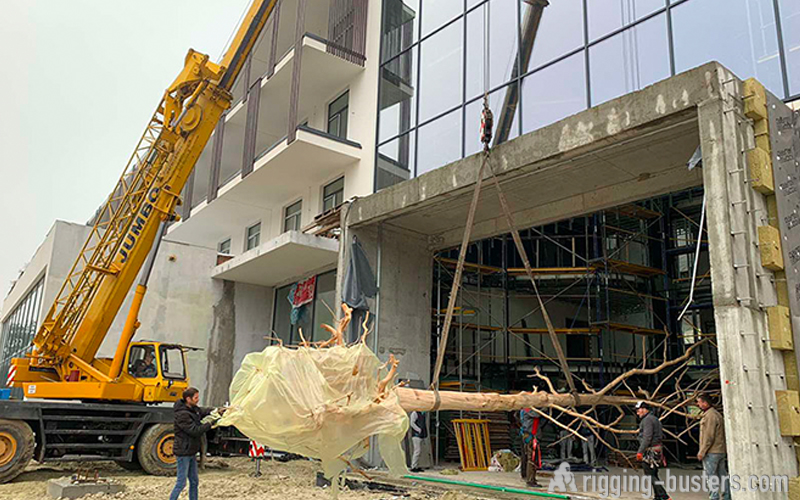
Moving a bronze statue or a granite monument, or installing a new sculpture before its unveiling? Rigging-Busters is a machinery moving and rigging company. Our professional riggers and lifters take the piece off its plinth, protect it, lift and haul it, then set it level on the footing or anchors your engineer designed.
We handle sculpture installation, relocation and removal across Ontario, with your conservator or the artist on site when the piece calls for it.
- Statues, sculptures and monuments: bronze, stone and steel pieces, outdoors or indoors.
- Handled to your brief: the conservator’s handling notes and the engineer’s anchor details come before any lift.
- Street permits in the plan: the city permit for a crane on the road, applied for to each city’s lead time.
- Minimum job: 3,500 CAD. Per project, before tax, so small garden pieces and decor fall below it.
- Quick replies: quotes within 2–4 business hours, and estimates are free.
- Equipment: jack-and-roll systems for loads up to 600 tons, hydraulic gantries, lift trucks up to 60,000 lb and float trailers for loads up to 50 tons.
- Insured: liability and workers’ compensation insurance (WSIB in Ontario), with a certificate of insurance on request.
Working to an unveiling date? Put it in your quote request with photos of the piece and both sites, and we plan back from that day.
or give a call +1-647-846-5179
Who We Work With on Statues and Monuments
We plan these moves for:
- Municipalities and public-art programs: a piece moved for road or park work, returned after conservation, or a new commission set on its base.
- Developers and public-art consultants: the public art installation that comes with a new building, set before the opening.
- Galleries, museums and sculpture parks: large works going on loan, into storage or to a new spot.
- Artists and fabricators: delivery from the studio or foundry and setting on the base, with the artist directing.
- Universities, hospitals and corporate campuses: donor sculptures and memorials moved for construction.
- Heritage sites: commemorative statues, cenotaphs and monuments, planned around any heritage consent.
Public-art budgets can include this work: Toronto’s Percent for Public Art guidelines recommend a contribution of at least one percent of a significant development’s gross construction cost, and the art budget it funds covers moving the finished work to the site, site preparation and below-grade elements.
How a Statue Move or Sculpture Installation Runs
Each move follows these nine steps, as the piece and the sites require:
- Survey: both sites, the route, the ground, overhead lines and where a crane and a truck can stand.
- Condition check: photos and notes with your conservator or the artist, and agreed handling points.
- Lifting points and frames: built-in lifting points where the piece has them; otherwise soft slings, padded cradles or a lifting frame made for it.
- Protection and crating: padding, wrap and a crate or braced cradle, with fragile parts removed as the artist directs.
- Permits: the street or road occupancy permit for the crane; the owner applies for any heritage consent, and whoever digs a new footing requests the utility locates.
- Crane lift: a crane partner supplies the crane with its operator; our riggers rig the piece, steady it with tag lines and land it.
- Transport: a flatbed, step-deck or float trailer, with the piece braced and strapped, on a route checked for clearances.
- Setting and anchoring: landed on its footing, plinth or base plate and fixed to the engineer’s anchor details.
- Final adjustments: level, plumb and facing checked with the artist or owner, protection removed, site left clean.
Footings and Anchors: Who Designs What
We set the piece; an engineer designs what holds it. Public-art contracts in Ontario often put that design on the artist’s side: Hamilton’s sample artist agreement asks the artist for stamped engineering drawings for all foundations, attachments and installation methods, and Thunder Bay’s guidebook has artists finalize designs with a structural engineer. For a work carried by a building, the Region of Waterloo’s transit-hub call has the artist engineer the artwork and the Region’s engineers design the structure that carries it. Send those drawings with your request; we install to them.
Insurance for the Artwork Itself
Insuring the artwork’s value is for the owner or the artist to arrange: the Region of Waterloo, for one, asks its artist for all-risk property insurance on the artwork’s value through creation and installation.
or give a call +1-647-846-5179
Permits and Street Work for a Crane Lift
Outdoor pieces often sit beside a road or sidewalk, so the crane may need to stand on public property, with a city permit and its own lead time:
- Toronto: a Street Occupation Permit covers hoisting with a mobile crane or boom truck. The municipal code asks for the application at least four working days ahead. Hoisting is charged per day ($73.89 + HST, or $92.35 + HST in a Construction Hub), plus lane-closure fees, and the City and any business improvement area where the work happens must be told at least 48 hours before it starts.
- Ottawa: hoisting with a mobile crane or boom truck on a City road, boulevard or sidewalk needs a temporary construction-related encroachment permit, which takes at least 10 business days to issue. A road closure needs 15 business days’ notice to the City and at least ten days’ notice to neighbours.
- Hamilton: a temporary lane and sidewalk occupancy permit needs at least 5 days’ notice; a full road closure needs at least 2 weeks’ notice, a traffic control plan and a notice to the neighbours.
- Other cities: London, Windsor, Kitchener, Waterloo and the rest set their own rules; we confirm the local permit in the quote.
Heritage, Buried Services and Power Lines
If a monument stands on a property designated under the Ontario Heritage Act, removing it can need the municipal council’s written consent, and council has 90 days to decide once the application is complete. Digging a new footing needs locates: the person digging must request them from Ontario Dig Authority (formerly Ontario One Call) at least 5 business days ahead, or 10 for a large site, and wait for every utility to respond. Overhead lines decide where the crane stands: Ontario’s construction regulation keeps any object at least 3 m from energized lines of 750 to 150,000 volts, more for higher voltages.
What a Statue or Monument Move Costs
We price each move as one job, from the piece and both sites:
- The piece: weight, size, material and how fragile it is
- Rigging: built-in lifting points, or slings, cradles and a lifting frame made for it
- The old base: how the piece is fixed to it, and whether the plinth moves too
- The crane: its size, reach and hours on site
- Access: lawns, paths, steps, doorways and soft ground at both ends
- Permits and timing: street permits, lane closures, early-morning or weekend work
- Crating and storage: a crate or cradle, and storage if the new base isn’t ready
- The haul: distance, trailer type and any oversize permit
Jobs start at 3,500 CAD per project, before tax. A move that needs a crane, crating and a street permit fits well; a single small garden piece does not. See how jobs are priced on our pricing page.
Not a Fit
We don’t take cemetery headstones or grave markers (monument companies usually set those), garden ornaments and small decor under our 3,500 CAD minimum, restoration or conservation work itself (we work alongside your conservator), or fine-art packing and shipping of small works. We also don’t design footings or anchors, or rent out a crane on its own.
Areas We Cover in Ontario
We cover the whole province, with the same plan in every city:
- Toronto and the GTA: Toronto’s Percent for Public Art Program began in 1985; the City’s Public Art Strategy 2020–2030 counted about 300 works from private developers.
- Ottawa: the Official Plan sets aside one percent of eligible municipal construction budgets for public art.
- Hamilton and Niagara: Hamilton, Burlington, St. Catharines and the rest of the region.
- Kitchener-Waterloo: Kitchener, Waterloo, Cambridge and the rest of Waterloo Region.
- London: under the City’s Public Art and Monument Program, the Culture Office works with each artist on fabrication, transportation, installation and conservation.
- Windsor: Windsor and Essex County.
- The rest of Ontario: Brantford, Guelph, Barrie, Oshawa, Kingston and smaller towns.
Pieces going to or from Quebec are planned the same way. For other work in these cities, see our pages for Toronto, Ottawa, Hamilton, London and Windsor.
or give a call +1-647-846-5179
What You Get With Our Riggers
- One crew from plinth to plinth: removal, crating, rigging for the lift, transport and setting.
- Set to the drawings: level, plumb and anchored as the engineer detailed.
- Permits planned early: street and lane permits built into the schedule.
- Planned back from your date: unveiling, ceremony or construction deadline.
- One quote for removal, crating, crane lift, transport and setting.
- Quick answers: quotes within 2–4 business hours.
Your Quote Checklist
Send these with your quote request and we reply within 2–4 business hours with a quote, noting anything the site survey still has to confirm:
- The piece: material, dimensions and weight if known
- Photos: all sides, the base and how the piece is fixed to it
- Drawings: base, footing and anchor drawings for the new site, or the engineer’s details
- Both sites: addresses, crane and truck access, ground, overhead lines, and door and floor limits indoors
- Your team: the conservator, artist or engineer we should work with
- Paperwork: any insurance, certificate or site-safety requirements in your contract
- Dates: when the piece can move, any unveiling or ceremony deadline, and how long it may need storage
Related Services in Ontario
Go straight to a related service:
- Crane Rigging & Heavy Lifting in Toronto, ON
- Machinery & Heavy Equipment Transport in Ontario
- Heavy Equipment Loading & Unloading in Toronto, ON
- Machinery & Heavy Equipment Movers in Ontario
Statue and Sculpture Moving in Ontario: FAQ
It is priced per job: the piece’s weight and size, the rigging, the crane, access at both sites, permits and the haul. Jobs start at 3,500 CAD per project, before tax, so small garden pieces fall below our minimum. Send photos, dimensions and both addresses for a quote within 2–4 business hours.
Usually, if the crane stands on a road, sidewalk or boulevard. Toronto’s Street Occupation Permit is applied for at least four working days ahead, Ottawa takes at least 10 business days to issue its encroachment permit, and Hamilton asks for at least 5 days’ notice for a lane occupancy.
If the property is designated under the Ontario Heritage Act, removing a structure or a heritage attribute can need the council’s written consent, and council has 90 days to decide once the application is complete. Talk to the municipality’s heritage staff early.
An engineer. For new public-art commissions, Ontario contracts often put this on the artist’s side: Hamilton’s sample agreement, for example, asks the artist for stamped engineering drawings for the foundations. We don’t design footings; we set and anchor the piece to the engineer’s drawings.
Insuring the artwork’s own value is for the owner or the artist; Hamilton’s sample agreement, for example, keeps the work at the artist’s risk until delivery. We carry liability and workers’ compensation insurance, with a certificate of insurance on request, and the quote confirms what it covers.
Yes. We check the piece’s condition with them, follow their handling notes and lifting points, and keep them on site for the lift and the setting if they wish.
From built-in lifting points where the artist provided them; otherwise with soft slings, padded cradles or a lifting frame, placed where the conservator agrees. Tag lines keep it steady, and it travels padded and braced. Where a crane can’t reach, gantries, skates or a lift truck do the work.
Yes. Send the date with your request and we plan back from it. Lead times to allow for: at least four working days’ notice for Toronto’s street permit and at least 10 business days for Ottawa to issue its permit; 5 business days for locates on a new footing (10 for a large site); and, where heritage consent is needed, 90 days for council to decide once the application is complete. The footing must be ready to the engineer’s specification before the piece goes on.
Yes. If the new base isn’t finished when the piece must leave its old site, it can be crated and stored, then delivered and set once the footing is done. Give us both dates and we price the storage with the move.
No. Headstones and grave markers are usually set by monument companies, and garden ornaments typically fall under our 3,500 CAD minimum. We take public statues, memorials, cenotaphs and large sculptures that need rigging, a crane or crating. Send yours with the quote request form.